
Reviewed · AMAZON JUNGLE TOURS
Manaus City Tour – The Highlighs of the Rubber Boom Time
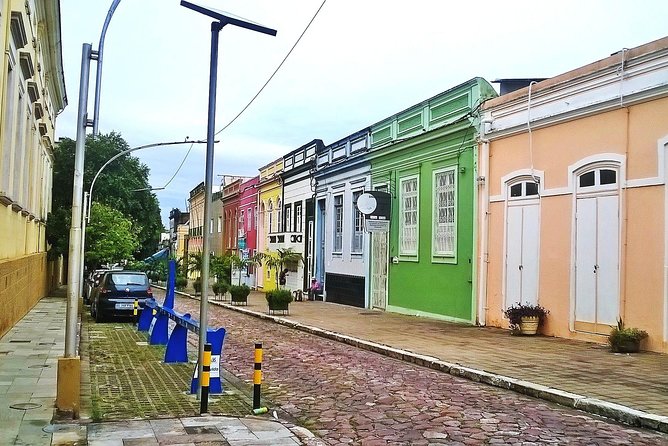
Manaus wears its rubber-boom past proudly. This private city tour connects the grand Teatro Amazonas with markets, palaces, museums, and river views, giving you a useful first look at Brazil’s Amazon capital without wrestling with taxis or city traffic.
I like the included opera house visit and the freedom of a private guide who can adjust the pace. I also like the air-conditioned car or van and hotel pickup, especially in Manaus’s hot, humid climate. The main caution is timing: the published stops add up to a little more than four hours, so you may need to move along, and bad weather or Sunday closures can affect the plan.
In This Review
- Key points to know before booking
- Why the rubber boom changed Manaus
- Teatro Amazonas, Manaus’s grandest surprise
- Adolpho Lisboa Market and the everyday Amazon
- Palacio Rio Negro and the city’s former elite
- Jefferson Peres Park and a changing city center
- Museu da Cidade de Manaus and the story of the city
- Mirante Lúcia Almeida and the Rio Negro
- The Port Opening Monument beside the opera house
- Private transport, guides, and the pace of the day
- Is $100 per person good value?
- Who should book this Manaus tour?
- Should you book it?
- FAQ
- How long does the Manaus city tour last?
- What is included in the price?
- Is the tour private?
- Is a minimum booking required?
- Does the tour include Teatro Amazonas?
- What happens if bad weather cancels the tour?
Key points to know before booking
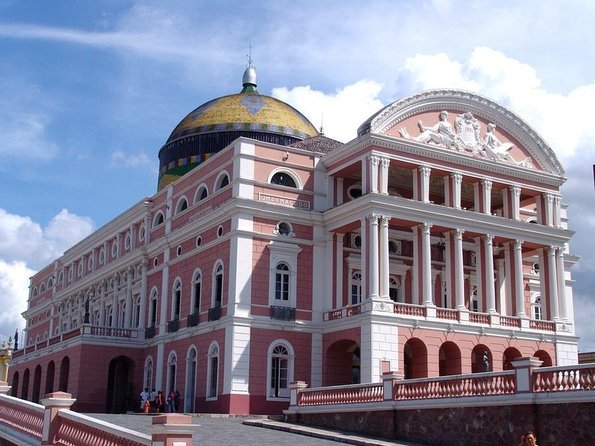
- Teatro Amazonas is the star attraction: Your admission ticket includes an indoor visit to Manaus’s famous 1896 opera house.
- The tour is genuinely private: Only your group participates, with transport by car or van and a dedicated guide.
- Rubber-boom Manaus comes into focus: The route links European-style buildings with markets, monuments, and government palaces.
- English-language guiding has been a major strength: Guides including Rodolpho, Kemal, Diogo, and Sardes have been praised for clear explanations and friendly service.
- The $100 price is per person: A minimum of two people applies, so solo visitors pay for two places.
- Allow for weather and opening-hour problems: Heavy rain has shortened tours before, and some attractions may close early, particularly on Sundays.
Why the rubber boom changed Manaus
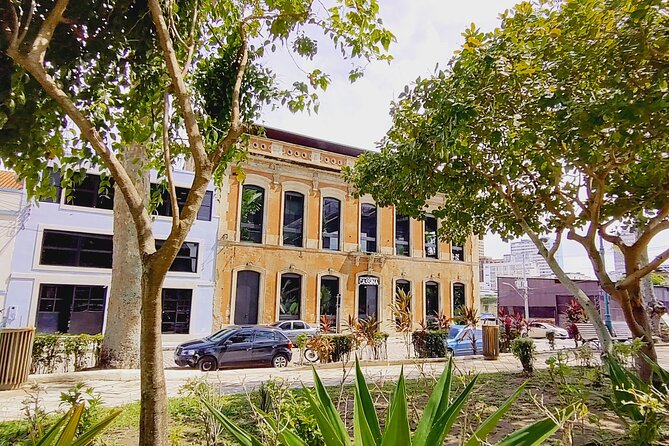
Manaus sits on the Rio Negro, far inland in the Amazon, yet its historic center contains an opera house with European chandeliers, imported ironwork, and elegant public buildings. That contrast is the point of this tour.
During the late 19th century, rubber made Manaus wealthy. Latex from Amazonian trees was valuable for industry, and local businessmen spent freely on imported materials, grand residences, public buildings, and cultural projects. The result was an unusual city center where Amazonian products once passed through markets while European design shaped the streets around them.
I find this context more useful than seeing the buildings one by one. The opera house is not simply a pretty theater. The market is not just a place to buy fruit. Together, they show how global trade changed a remote river city.
The tour lasts about four hours and includes hotel pickup and drop-off. It is a good choice if you have one free morning or afternoon, are stopping in Manaus before or after an Amazon cruise, or want an orientation before exploring on your own.
More Rio city tours:
- Manaus: Half-Day City Tour
★ 4.0 · 94 reviews - Private Historic City-tour through the centre OF Manaus
★ 5.0 · 51 reviews - City Tour in Manaus at Teatro Amazonas and Praça da Matriz
★ 4.5 · 35 reviews
Teatro Amazonas, Manaus’s grandest surprise
The indoor visit to Teatro Amazonas takes about an hour, and this is where I would expect the tour to spend its most rewarding stretch of time.
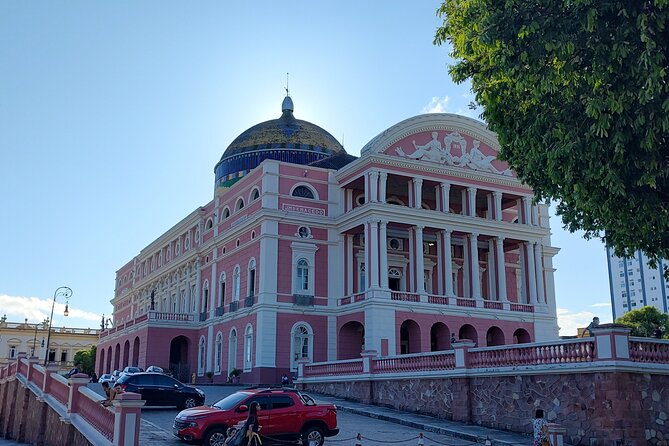
The opera house opened in 1896, at the height of the rubber boom. Its most memorable feature is the dome, covered with 36,000 ceramic tiles painted in the colors of Brazil’s flag. Inside, you can expect European decoration, Murano chandeliers, jacaranda wood floors, and the polished elegance that wealthy Manaus hoped would place it on the cultural map.
The building’s appeal is visual, but a guide adds the needed explanation. You learn why such an ornate theater appeared in an Amazonian city and how rubber wealth paid for materials shipped from Europe. That story gives the architecture some weight. Otherwise, it is easy to admire the ceiling and miss the strange economic forces behind it.
The ticket is included, which matters because this is the one major paid admission clearly covered by the tour. Several people have singled out the opera house as the highlight, and I understand why. It is the kind of place that makes Manaus feel unlike any other Brazilian city.
Wear smart casual clothing, as requested by the operator. Comfortable shoes are still sensible because this is a walking visit, and the full tour requires a moderate level of physical fitness.
Adolpho Lisboa Market and the everyday Amazon
The Adolpho Lisboa Municipal Market provides a useful change of mood after the formal theater. Plan on about 30 minutes here, with no extra admission charge.
The market opened in 1883 and uses Art Nouveau ironwork imported from Europe. Some of that ironwork has been linked to Gustave Eiffel, though the supplied tour information presents this as an attribution rather than a firm fact. Either way, the structure itself is worth noticing.
Inside, the emphasis shifts from grand public culture to daily commerce. You might find exotic fruits, medicinal herbs, fresh fish, and indigenous crafts. The market also mixes goods for local residents with items aimed at visitors, so do not expect a purely traditional scene. That mixture is useful. It shows the market as a working place rather than a staged attraction.
A good guide can make this short stop count. Rodolpho was praised for pointing out items and explaining what interested the group, while another guide helped explain how the market serves both local people and tourists. You should feel free to ask questions here, especially if you want to understand Amazonian ingredients or crafts rather than simply take photographs.
Thirty minutes is enough for an introduction, but not enough for a slow market exploration. If the market matters most to you, tell your guide early. A private tour gives you a better chance of adjusting the pace than a large group outing.
Palacio Rio Negro and the city’s former elite
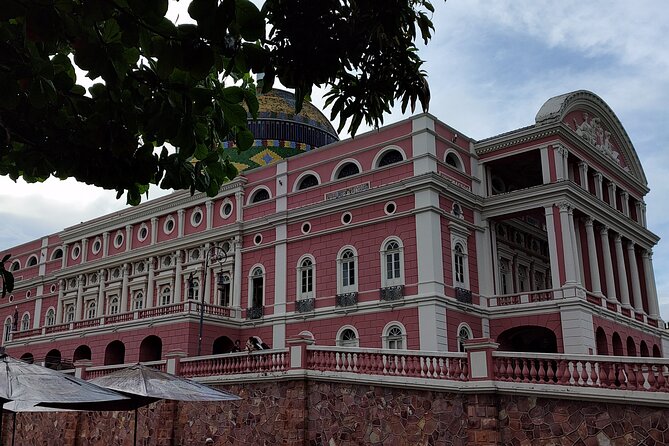
Palacio Rio Negro takes you back to the private world created by rubber wealth. The mansion was built in 1903 for German rubber baron Waldemar Scholz. In 1918, it became the official seat of the Amazonas government. Today, it functions as a cultural center and museum.
The visit lasts about 30 minutes and admission is free. Inside, you can see period furniture, art displays, historical objects, a grand staircase, and imported iron sculptures. The gardens connect with Jefferson Peres Park, adding an outdoor element to the stop.
I like this part of the route because it gives the rubber boom a human scale. Teatro Amazonas shows public ambition. The palace shows how one wealthy businessman lived. The two buildings belong to the same era, but they tell different stories.
The short visit may feel rushed if you enjoy interiors and want to examine every room. Still, the guide’s commentary helps you focus on the details that matter. Several guides have been praised for answering questions clearly and explaining the connection between Manaus’s buildings and its past.
More Amazon jungle trips:
- From Manaus: One-Day Amazon Jungle Experience
★ 4.8 · 408 reviews - Manaus: Full-Day Tour on the Amazon River
★ 4.2 · 362 reviews - Indian Village and Meeting of the Waters Tour
★ 4.5 · 241 reviews - A Whole Day in the Jungle
★ 5.0 · 155 reviews
Jefferson Peres Park and a changing city center
Jefferson Peres Park is a brief stop, listed at about 10 minutes. The area was recently developed on ground that had previously contained slums and is now used for entertainment.
Do not expect a long park walk. The tour passes through and makes a short visit. Its value is mainly urban rather than scenic: you get a quick sense of how Manaus is reshaping parts of its center.
This is also one of the stops most likely to be shortened if traffic, rain, or a longer museum visit takes priority. That is not necessarily a problem. On a four-hour city tour, a short look at a modern public area can help balance the older buildings, but it is not a reason by itself to book the experience.
Museu da Cidade de Manaus and the story of the city
The Museu da Cidade de Manaus is scheduled for about an hour and is described as a place where you can see how the city began and how it changed through different periods.
This should be one of the more helpful stops for first-time visitors. The opera house and palace show the city at its most polished. A city museum can connect those grand symbols with the wider growth of Manaus and the different phases it passed through.
The museum is free, but opening hours deserve attention. One unhappy experience involved a Sunday visit during torrential rain, when some sites closed after midday and the planned museum visit could not happen. The operator explained that the museum was not part of the shorter alternative tour being provided in that situation. I would confirm the day’s operating hours if your schedule is tight, especially on a Sunday.
The supplied information lists Museu da Cidade de Manaus twice, but the second description is actually for Mirante Lúcia Almeida. Treat them as separate places, not one repeated museum stop.
Mirante Lúcia Almeida and the Rio Negro
Mirante Lúcia Almeida opened in April 2024 in Manaus’s historic center. It is a cultural and leisure complex with panoramic views toward the Rio Negro and the Meeting of the Waters.
The planned visit is about 30 minutes, with admission included. This adds a newer side of Manaus to a route otherwise focused on 19th and early 20th-century buildings. The viewpoint is intended to link nature, city life, history, and urban renewal.
You will not spend hours here, but half an hour is enough to pause, take in the river setting, and understand Manaus’s position beside the Rio Negro. For a city tour centered on buildings, that river outlook is a welcome change.
Because the site only opened in 2024, it also shows that Manaus is not frozen in its rubber-boom past. The city is still adding public spaces and reshaping the historic center. If you enjoy seeing how a city presents itself today, this stop adds real value.
The Port Opening Monument beside the opera house
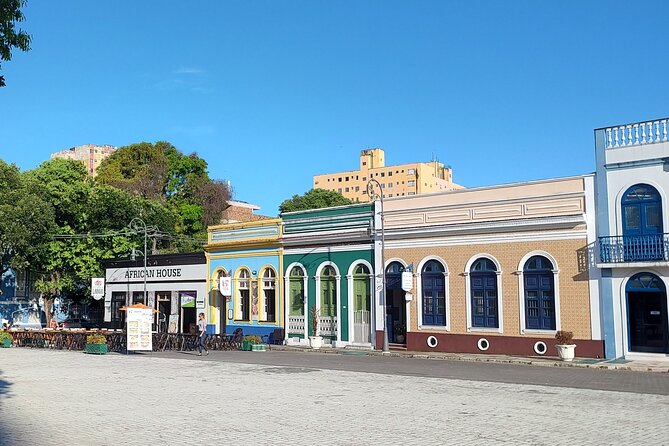
The Monumento à Abertura dos Portos sits in Largo de São Sebastião, directly in front of Teatro Amazonas. The visit takes about 20 minutes and admission is free.
The monument commemorates the opening of Amazonian ports to international trade in 1866. It was inaugurated in 1900 and designed by Italian artist Domenico de Angelis. Its sculptures represent Asia, Africa, Europe, and America, each shown through a ship with a seated child. At the top are Mercury, the Roman god of commerce, and a female figure representing the Amazon.
This is a small stop, but it explains why Manaus became connected to world markets. Look closely at the symbols, then relate them to the market and opera house nearby. The entire square works as an open-air history lesson.
Since the monument is beside the theater, your guide can explain both together. If you rush past it, you miss an important clue about the city’s commercial ambitions.
Private transport, guides, and the pace of the day
Hotel pickup and drop-off are included, and the tour uses a private car or van. In Manaus, air conditioning is more than a comfort detail. It gives you a cool break between outdoor stops and makes the half-day schedule easier to manage.
The private format is one of the strongest reasons to consider this tour. You do not have to match the pace of a busload of strangers, and your guide can respond to your interests. If you care most about architecture, ask for more explanation at the theater and palace. If the market interests you, request extra attention there when time allows.
Several named guides have received strong praise. Rodolpho is repeatedly described as friendly, prompt, and clear in English, with a new, comfortable air-conditioned car. Kemal was praised for fluent English, good humor, and strong local knowledge. Diogo was easy to understand, translated questions well, and worked with a courteous driver named Hising. Sardes was also praised for an informed explanation and a comfortable vehicle.
That does not guarantee which guide you will receive, so I would confirm your language needs when booking. The overall rating is 4.9 from 60 ratings, with 98 percent recommending the experience, which points to a consistent level of satisfaction. Still, one poor experience shows why weather, opening hours, and precise expectations matter.
Is $100 per person good value?
At $100 per person, this is not the cheapest way to look around Manaus. The comparison changes when you consider what is included: private transport, hotel pickup and drop-off, a professional guide, and admission to Teatro Amazonas.
The minimum booking is two people. A solo visitor must pay for two places, which was the clearest price complaint in the feedback. For a couple, the price is easier to justify because you are paying for a private vehicle and personalized guiding rather than two seats on a large group bus.
I think the price works best for cruise passengers, couples, families, and small groups with limited time. It is also useful if you want English-language help and do not want to sort out transport between scattered historic sites.
The value is weaker if you are happy to explore slowly on foot, already know Manaus, or mainly want to browse the market. In that case, the included private vehicle and guide may offer more than you need.
Who should book this Manaus tour?
I would choose this tour if you want a clear introduction to Manaus in one half-day. It suits you particularly well if your cruise schedule gives you only one day, if you prefer a private car, or if architecture and city history matter as much as Amazon excursions.
It also suits families and older visitors who appreciate hotel transfers and a controlled pace. Children must be accompanied by an adult, and everyone should be prepared for moderate physical activity.
I would be more cautious if you expect a long market visit, extensive museum time, or a full exploration of every stop. The schedule is broad for four hours, and the listed stop times total roughly four and a half hours. Actual timing can change, so ask how the route will be handled on your date.
Book at least 24 hours before the start if you want the option of a full refund after cancellation. The tour requires favorable weather. If poor weather cancels it, you can choose another date or receive a refund. Cruise passengers should provide the ship name, docking time, disembarkation time, and re-boarding time, and late or missed ship arrivals are not refundable.
Should you book it?
Book it if you want the city explained, not merely photographed. The opera house is the main draw, but the market, palace, monument, museum, and river viewpoint make the visit more useful than a single landmark stop.
The best match is a pair or small group with one free half-day and a budget for private service. Solo visitors should think carefully about the two-person minimum. Also, confirm Sunday opening hours and allow for rain.
For most first-time visitors, I think this is a strong way to meet Manaus. It gives you the city’s rubber-boom drama, a look at daily commerce, and a glimpse of its newer public spaces, all without wasting your limited time on transport.
FAQ
How long does the Manaus city tour last?
The tour lasts approximately four hours. The listed visits total slightly more than four hours, so the exact time at each stop may vary.
What is included in the price?
The price includes a professional guide, hotel pickup and drop-off, private transport by car or van, and the entrance ticket for Teatro Amazonas. Food and drinks are not included unless specifically stated.
Is the tour private?
Yes. Only your group participates in the private activity.
Is a minimum booking required?
Yes. A minimum of two people per booking is required. Solo visitors must pay for two places.
Does the tour include Teatro Amazonas?
Yes. The tour includes a private indoor visit to Teatro Amazonas, and the admission ticket is included.
What happens if bad weather cancels the tour?
If poor weather causes cancellation, you will be offered an alternative date or a full refund. The experience is subject to favorable weather conditions.
Just added in Manaus
- Tree Climbing in the Amazon★ 4.5 · 6 reviews
- Tucandeira Ants Indigenous Ritual★ 4.5 · 4 reviews
- Walking Tours in Manaus★ 3.5 · 16 reviews
- 4-day Amazon River Boat Tour From Manaus★ 5.0 · 10 reviews
- Transfer service from Porto to Manaus Airport★ 5.0 · 2 reviews
- Amazon Safari Tour in Manaus (Shared)★ 5.0 · 3 reviews
- Transfer service from Iberostar (Port) to Manaus Airport★ 5.0 · 1 review
- Private Tour Waterfalls Iracema & Asframa President Figueiredo★ 5.0 · 3 reviews
Amazon Jungle Tours, compared.
Rio de Janeiro Tijuca Rainforest Hike with Waterfalls and Caves
Read our review →

Jungle Waterfalls and Cachaça Distillery Jeep Tour
Read our review →


Browse the lists this tour appears in