
Reviewed · AMAZON JUNGLE TOURS
Meeting of the Waters and Amazonas Opera House – Half Day Tour
Two rivers, one memorable morning. This private Manaus tour links the city’s grand rubber-boom buildings with a speedboat trip to the Meeting of the Waters, giving you both urban history and Amazon scenery in about four and a half hours. I like the one-to-one attention of a private guide and the fact that hotel pickup, transport, boat travel, and Opera House entry are arranged for you.
The main consideration is price: at $140 per person, this is not Manaus’s cheapest sightseeing option. You are paying for a private SUV, a professional guide, a covered speedboat, and a compact itinerary, so the value is strongest if you want comfort, flexibility, and two major sights in one outing.
In This Review
- Key things to know before booking
- Why this Manaus combination works
- Rio Negro Palace and Manaus’s rubber-boom past
- Adolpho Lisboa Market: the most grounded city stop
- Largo de São Sebastião and the port monument
- Teatro Amazonas: the tour’s grand indoor highlight
- From the industrial port to the Meeting of the Waters
- A floating community on the final river leg
- Timing, transport, and what the price buys
- What the guide can change for you
- Who should book this half-day tour?
- Should you book the Manaus city and river tour?
- FAQ
- How long does the tour last?
- Is hotel pickup and drop-off included?
- Is the tour private?
- What is included in the price?
- Are food and drinks included?
- Does the tour operate in languages other than English?
- What happens if bad weather cancels the tour?
Key things to know before booking
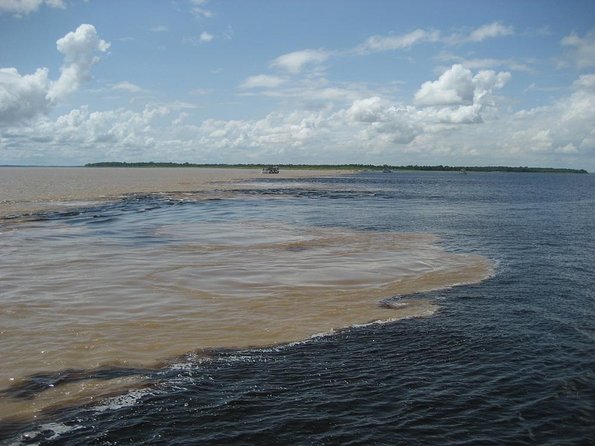
- The Meeting of the Waters is the centerpiece: A covered speedboat takes you to the point where the dark Rio Negro runs beside the sandy-colored Solimões without immediately blending.
- The tour combines city and river well: You visit the Adolpho Lisboa Market, Rio Negro Palace, the Amazonas Opera House, and the historic center before reaching the waterfront.
- Private transport saves time: Pickup and return at your Manaus hotel mean no public bus connections or negotiating city transport.
- Guide quality matters here: Rodolpho, also known as Rudy in some feedback, is praised for clear English, local knowledge, punctuality, and careful driving.
- It is a true half-day outing: Morning and afternoon departures leave room for another Manaus activity, although transfers and opening hours can affect the pace.
- Conditions can change the plan: The tour depends on good weather, and historic sites can occasionally close for maintenance or events.
Why this Manaus combination works

Manaus can feel like two cities at once. One is the proud center built during the rubber boom, filled with European-style buildings, grand public spaces, and imported materials. The other is the river city, where boats, floating homes, fishing, and agriculture shape daily life.
This tour lets you see both sides without spending a full day in a vehicle. You start with the historic quarter, then move through the market and old civic buildings before heading to the port. From there, the boat ride gives you a close look at the waterways that made Manaus important in the first place.
I especially like the balance. A standard city tour can leave you wondering where the Amazon itself is. A river-only excursion can miss the story of why Manaus grew so wealthy. This outing connects the two.
The group is private, with a maximum of 10 people, and transport is listed as an SUV for up to four people. The private setup is useful if you want to ask questions, adjust the pace, or help a family member who walks slowly. One guide, Rodolpho, received particular praise for taking extra care with a father’s mobility needs.
More Amazon jungle trips:
- From Manaus: One-Day Amazon Jungle Experience
★ 4.8 · 408 reviews - Manaus: Full-Day Tour on the Amazon River
★ 4.2 · 362 reviews - Indian Village and Meeting of the Waters Tour
★ 4.5 · 241 reviews
Rio Negro Palace and Manaus’s rubber-boom past
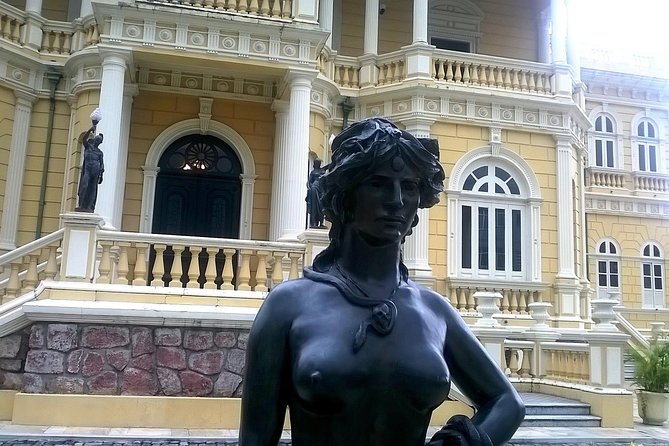
The Rio Negro Palace is a short but worthwhile stop. German rubber baron Waldemar Scholz built the mansion in 1903, when Manaus was benefiting from the rubber trade. It later became the seat of the Amazonas government and now functions as a cultural center and museum.
Inside, you can see period furniture, art, historical objects, a grand staircase, and imported iron decoration. The gardens connect with Jefferson Péres Park, giving you a little open space after time in the vehicle.
The visit is scheduled for about 20 minutes, and entry is free. That is enough for a focused introduction, though not enough for a slow museum visit. If you enjoy architecture and decorative interiors, you will want to listen closely as your guide explains how European tastes reached the middle of the Amazon.
One practical warning is important here. The palace, like the Opera House, can close for maintenance or special work. A previous customer found both buildings closed and felt the high price was difficult to justify without the included entries. The operator explained that the closure was unexpected and linked to renovation needs during the rainy season. It is worth confirming opening status shortly before your tour if these buildings are your main reason for booking.
Adolpho Lisboa Market: the most grounded city stop
The Adolpho Lisboa Municipal Market gives the tour a welcome change of pace. Built in 1883 during the rubber boom, it uses Art Nouveau ironwork imported from Europe. Some of the metal construction is often associated with Gustave Eiffel, though the supplied tour information describes the materials as European imports.
Inside, stalls offer Amazonian fruits, vegetables, fresh fish, medicinal herbs, and local handicrafts. This is not a polished museum display. It is a working market, and that makes it one of the better places on the route to see how Manaus connects with the river and forest.
Your 30-minute visit is long enough to walk through the main areas and ask about unfamiliar produce or ingredients. Food and drinks are not included, but you can buy them separately. I would treat this as a browsing stop rather than a full meal break, since the schedule still has the Opera House and river excursion ahead.
The market also gives your guide room to make the tour personal. Rodolpho was praised for his English and for adding thoughtful touches, including buying a birthday gift at the market for one couple. That kind of gesture cannot be guaranteed, but it shows why a private guide can feel more attentive than a large group escort.
Largo de São Sebastião and the port monument
The Monumento a Abertura dos Portos as Nações Amigas sits in Largo de São Sebastião, directly in front of the Amazon Theatre. It commemorates the 1866 opening of Amazonian ports to international trade, an event that helped Manaus connect with overseas commerce.
Italian artist Domenico de Angelis designed the neoclassical monument, inaugurated in 1900. Its sculptures represent Asia, Africa, Europe, and America, with each continent shown through a ship and seated child. Mercury, the Roman god of commerce, appears at the top beside a female figure representing the Amazon.
The planned stop lasts about 30 minutes and costs nothing to enter. The monument itself does not require much time, but the square helps you understand the Opera House’s setting. You are not seeing an isolated theater dropped into the jungle. You are seeing a public district built to express Manaus’s confidence during its wealthiest period.
This is also a good photo stop and a useful moment to hear the larger story before entering the theater. The area has been revitalized, and the pairing of the monument, square, and Opera House makes this part of the city easy to explore on foot.
More things to do in Manaus:
- A Whole Day in the Jungle
★ 5.0 · 155 reviews - From Manaus: Presidente Figueiredo Waterfalls Daytrip
★ 4.3 · 149 reviews - 3 Days Amazon Jungle Adventure Tour
★ 4.0 · 145 reviews - Amazing Waterfalls of the Amazon – Presidente Figueiredo
★ 4.5 · 141 reviews
Teatro Amazonas: the tour’s grand indoor highlight
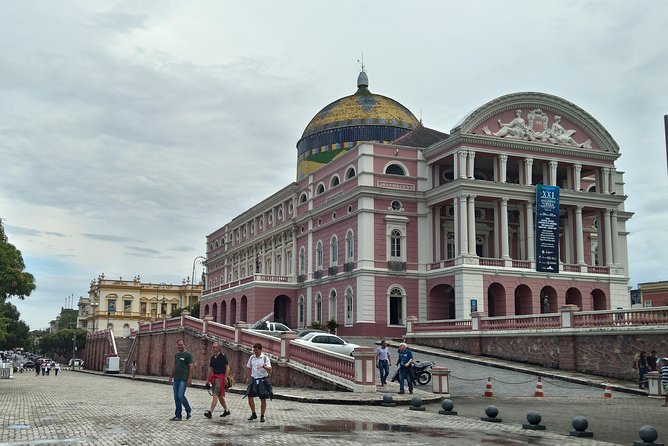
The Amazonas Opera House, or Teatro Amazonas, is Manaus’s most famous building. It opened in 1896, when rubber profits allowed local leaders and wealthy merchants to commission an opera house filled with European materials and design.
Look up at the dome, which uses 36,000 ceramic tiles painted in the colors of Brazil’s flag. Inside, the building features Murano chandeliers, jacaranda wood floors, and ornate Belle Époque details. The contrast is striking: grand opera architecture in a city surrounded by one of the world’s great river systems.
The visit is scheduled for one hour, and admission is included. That makes this the longest city stop and gives you time to appreciate more than the exterior. Your guide can explain the building’s role in Manaus and point out architectural details that are easy to miss if you simply walk through with a camera.
One unusual possibility is seeing a rehearsal. A couple visiting during a practice session was allowed to watch, but this is not promised and depends entirely on what is happening at the theater that day. Do not book the tour expecting a performance. Book it for the building, then regard a rehearsal as a lucky extra.
The Opera House is also where the $140 price begins to make more sense. If you booked a basic city transfer, you would still need to arrange entry and find your way between the historic center and riverfront. Here, the ticket, guide, vehicle, and explanation are bundled together.
From the industrial port to the Meeting of the Waters
After the city sights, you travel by vehicle through the industrial port area toward the riverfront. This transition matters because it shows Manaus as a working river city, not only as a historic center dressed up for sightseeing.
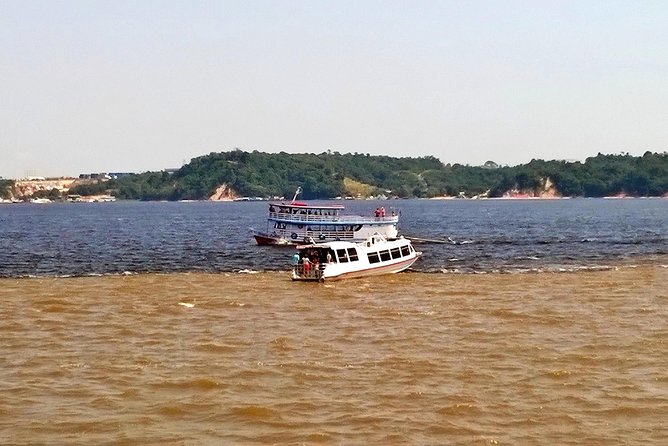
The covered speedboat and pilot are included. The ride takes you to the Meeting of the Waters, where the nearly black Rio Negro flows beside the lighter, sandy-colored Solimões. For several miles, the rivers run side by side without blending quickly because of differences in temperature, speed, and water composition.
The sight is easy to understand and still remarkable. You do not need a long scientific lecture to appreciate the clean color division from the boat. Your guide can explain how the two waterways come together to form the Amazon River, making this one of the few stops where a geographic fact becomes immediately visible.
The boat portion is scheduled for about 30 minutes at the Meeting of the Waters, not counting every transfer and the next river stop. The boat is covered, which is useful in strong sun and sudden rain, but you should still expect heat, spray, and movement. A moderate level of physical fitness is requested, so tell the operator in advance if anyone in your group has difficulty boarding or walking.
Weather is a real factor. If conditions are poor, the operator may cancel and offer another date or a full refund. That policy is reasonable for a river excursion, though it means your plans need some flexibility.
A floating community on the final river leg
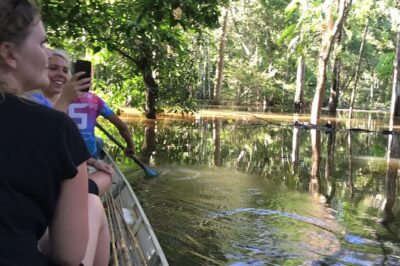
The tour continues to a floating village, where residents live in houses built on or beside the water. Fishing and agriculture are described as the main activities, and the boat moves slowly through the community so you can observe how life is organized around the river.
This is a useful counterpoint to the grand Opera House. Manaus’s history is not only about wealthy merchants and imported European decoration. It also includes people whose homes, work, and transport depend on changing water levels and boat access.
The stop is observational rather than a long activity session. You should approach it with respect and avoid treating homes as scenery. The value lies in seeing a form of daily life that is difficult to understand from a downtown museum.
Some tours also pass areas of submerged forest, but that detail is not listed as a guaranteed stop, so I would not count on it. The reliable promise is a slow navigation through a floating community before returning to land and your hotel.
Timing, transport, and what the price buys
The tour lasts about four hours and 30 minutes, with morning or afternoon departure choices. The listed visits add up to several hours before you count driving, port access, boat boarding, and the return transfer. That means the schedule is active, not leisurely.
Hotel pickup and drop-off are included, along with a professional guide and driver. The vehicle is described as a private SUV for four people, while the total booking limit is 10. Ask how your party will be arranged if you have more than four people, since the transport description is clearest for smaller groups.
At $140 per person, I would call the price fair for visitors who value convenience and personal attention, but high for independent budget travelers. You are paying for a private experience rather than simply paying to enter the Opera House and take a public boat.
The value improves if you are staying only briefly in Manaus, arriving from a cruise ship, or traveling with older relatives. Cruise passengers must provide ship name, docking time, disembarkation time, and re-boarding time when booking. Pickup at the gangway can cost an extra $10 per entrance, and missed tours caused by a late or absent ship do not qualify for a refund.
The operator requires at least two people per booking. Children must be accompanied by two adults, and the suggested dress code is smart casual. Food and drinks are extra, so bring some spending money for the market rather than expecting lunch to be part of the outing.
What the guide can change for you
The strongest part of this experience is not simply the list of buildings. It is the guide’s role in connecting them.
Rodolpho is praised for excellent English, clear explanations, kindness, punctuality, and careful driving. Daniel is also described as flexible, friendly, and well informed. Other bookings mention guides named JP and Billy, so the exact person is not guaranteed.
That matters because the itinerary moves quickly. At the palace, you need context to understand the imported furnishings. At the market, you need help identifying unfamiliar food and crafts. At the Opera House, a guide can turn decorative details into a story about Manaus’s rubber wealth. On the river, a good explanation makes the Meeting of the Waters more than a short boat ride to a line between two colors.
Private touring also lets you ask for help with mobility needs or adjust the amount of time spent at a stop, within the fixed schedule. It does not mean unlimited time. If you linger at the market, the Opera House or boat portion may need to move faster.
Who should book this half-day tour?
I would recommend it to first-time visitors who want a clear introduction to Manaus without committing an entire day. It suits couples, families, cruise passengers, and anyone who prefers a private car over public transport.
It is especially useful if you want both the city’s major historic sights and a direct look at the rivers. The tour also works well for visitors with limited time, since the rest of your day remains open.
I would hesitate if you are looking for a slow museum visit, an extended wildlife outing, or a low-cost group excursion. The floating village visit is brief, and the speedboat ride is focused on the Meeting of the Waters rather than a full Amazon expedition.
Free cancellation is available up to 24 hours before the start time. Changes or cancellations inside that window are not refunded, and poor weather can alter the schedule. If the minimum number of people is not met, you should be offered another date, another experience, or a refund.
Should you book the Manaus city and river tour?
Book it if you want an efficient first look at Manaus, especially with a private guide who can explain both the rubber boom and modern river life. The Meeting of the Waters is the unforgettable part, but the Opera House, market, palace, and port route give that river experience useful context.
At $140 per person, it is best viewed as a convenience purchase. You get hotel transfers, private road transport, a pilot and covered speedboat, guide service, and Opera House entry in one package. Confirm the language, since the standard service is English unless you request another language, and check that the Opera House and palace are open if those stops are essential.
For most first visits, I think the combination earns its price. It covers a lot of ground, leaves time for the rest of Manaus, and gives you a better sense of the city than a river stop or downtown walk alone.
FAQ
How long does the tour last?
The tour lasts approximately four hours and 30 minutes.
Is hotel pickup and drop-off included?
Yes. Pickup and return to your Manaus hotel are included.
Is the tour private?
Yes. Only your group participates, with a maximum of 10 people per booking.
What is included in the price?
The price includes hotel transfers, a professional guide and driver, private vehicle transport, the speedboat and pilot, and admission to the Amazonas Opera House.
Are food and drinks included?
No. Food and drinks are not included, though they are available to purchase.
Does the tour operate in languages other than English?
The standard tours are in English. You can request a specific language when booking, but it is best to confirm availability.
What happens if bad weather cancels the tour?
If poor weather causes cancellation, you will be offered an alternative date or a full refund.
Just added in Manaus
- Tree Climbing in the Amazon★ 4.5 · 6 reviews
- Tucandeira Ants Indigenous Ritual★ 4.5 · 4 reviews
- 4-day Amazon River Boat Tour From Manaus★ 5.0 · 10 reviews
- Walking Tours in Manaus★ 3.5 · 16 reviews
- Transfer service from Porto to Manaus Airport★ 5.0 · 2 reviews
- Amazon Safari Tour in Manaus (Shared)★ 5.0 · 3 reviews
- Transfer service from Iberostar (Port) to Manaus Airport★ 5.0 · 1 review
- Private Tour Waterfalls Iracema & Asframa President Figueiredo★ 5.0 · 3 reviews
Amazon Jungle Tours, compared.
Rio de Janeiro Tijuca Rainforest Hike with Waterfalls and Caves
Read our review →

Jungle Waterfalls and Cachaça Distillery Jeep Tour
Read our review →


Browse the lists this tour appears in