

Reviewed · CHRIST THE REDEEMER AND SUGARLOAF
Rio’s Best_Corcovado, Sugar Loaf, Selaron, Cathedral and more
Rio rewards a packed first day. This tour gives you Christ the Redeemer and Sugarloaf Mountain in one outing, then adds downtown churches, Carnival landmarks, colorful Selarón Steps, and famous beaches. I like the hotel pickup, careful driving, and the small group limit of 19 people. I also like the guides, including Sabina, Victoria, Lucia, Meilin, and Heraclito, who are praised for clear explanations and good time control.
The main catch is simple: the base price does not include the major attraction tickets or lunch. You need to select the higher-priced option if you want admission to Christ the Redeemer and the Sugarloaf complex, plus the Brazilian barbecue buffet. The day is long and busy, and traffic can change the afternoon plan.
In This Review
- Key points before you book
- What this Rio day tour is really designed to do
- Corcovado first, with the best chance of clear views
- Sugarloaf by two cable cars
- Lunch at a Brazilian churrascaria
- Maracanã and the Sambadrome from the outside
- Selarón Steps and the art of Lapa
- Two churches, two very different Rio interiors
- Beaches and neighborhoods from the vehicle
- How the guide and vehicle affect the day
- Is $109.50 good value?
- Who should book this tour?
- The bottom line for a first day in Rio
- FAQ
- Where does the tour start?
- What time does the tour begin?
- Are Christ the Redeemer and Sugarloaf tickets included?
- Is lunch included?
- Does the tour enter Maracanã Stadium?
- Can the itinerary change during Carnival?
Key points before you book
- Christ the Redeemer and Sugarloaf come first: The tour handles Rio’s two biggest sights before the city traffic and heat build.
- The afternoon adds real local character: Selarón Steps, Lapa, the Metropolitan Cathedral, and São Bento Monastery show a very different side of Rio.
- The barbecue lunch is an optional upgrade: The churrascaria includes a large salad bar and table-served meats, but drinks and dessert cost extra.
- A guide saves serious time: Pickup, transfers, meeting points, and attraction access are managed for you.
- The group is capped at 19: That is small enough for a more personal day, though the minibus still needs to move through a crowded city.
- Carnival can change the route: Christ the Redeemer and Sugarloaf are protected parts of the plan, but some afternoon stops may be dropped because of road closures.
What this Rio day tour is really designed to do
This is a greatest-hits tour, not a slow neighborhood walk. In roughly eight to nine hours, you cover mountain views, beaches, football, Carnival, colonial religious art, modern architecture, and central Rio streets.
I would use it as an introduction to the city. You get a clear sense of Rio’s shape and contrasts: forested hills rise behind dense neighborhoods, famous beaches curve along the South Zone, and the center changes pace with churches, aqueducts, museums, and old streets.
The schedule starts at 7:30 am. Pickup and drop-off are offered at selected hotels in Leme, Copacabana, Ipanema, and Leblon. If you are staying elsewhere, the stated meeting point is the Hilton Rio de Janeiro Copacabana on Avenida Atlântica.
The operation uses a licensed, multilingual guide and transportation between stops. That matters in Rio. The attractions are spread across the city, and this is not a route I would try to stitch together by public transport in a single day.
More Redeemer and Sugarloaf tickets:
- Christ the Redeemer Entry Ticket by Corcovado Train
★ 4.4 · 4,476 reviews - Rio’s City Tour – Tickets for Christ, Sugar Loaf & Lunch included
★ 5.0 · 4,389 reviews - Full Day: Christ Redeemer, Sugarloaf, City Tour & Barbecue Lunch
★ 4.5 · 3,142 reviews
Corcovado first, with the best chance of clear views
The first major sight is Christ the Redeemer on Corcovado Hill, reached through Tijuca Forest. At Paineiras, you board the official vehicles used to reach the summit area inside the national park.
The statue is 38 meters tall and made of reinforced concrete covered with thousands of triangular soapstone tiles. The statue itself is impressive, but the real prize is the view. From the top, you can see Rio spread around the mountains, bay, lagoons, and beaches.
The listed time at Corcovado is about 45 minutes. That gives you enough time to see the statue, take photographs, and look out across the city, but it is not a leisurely visit. The summit can fill quickly, particularly during holidays and high season.
The tour wisely places Corcovado early. Morning light and weather are never guaranteed, but an early start gives you a better shot at avoiding the worst crowds and late-day haze. Bring water, wear shoes with a firm sole, and keep your phone or camera ready. You will be moving through a popular site with limited time.
If visibility is poor at the summit, the alternative is Mirante Dona Marta. This viewpoint offers views toward Sugarloaf, Christ the Redeemer, Maracanã Stadium, Guanabara Bay, and Rodrigo de Freitas Lagoon. It is a strong backup, but it is not the same experience as standing beneath the statue.
Sugarloaf by two cable cars
After Corcovado, the group heads to Sugarloaf Mountain. The ascent comes in two stages.
The first cable car rises to Morro da Urca, about 220 meters above sea level. The second continues to the summit of Sugarloaf, about 396 meters high. Even before reaching the top, Morro da Urca offers wide views of Guanabara Bay and the city.
At Sugarloaf, you can look across Copacabana, Ipanema, Leblon, Flamengo, Botafogo, the Tijuca Massif, Corcovado, downtown Rio, Niterói, and the Rio-Niterói Bridge. On a clear day, the view explains Rio’s famous nickname without much help from a guide.
The stated visit at Sugarloaf lasts about 30 minutes, followed by about 15 minutes at Morro da Urca. That is enough for photographs and a quick look around, but not enough to linger at every viewpoint. The cable cars can also become crowded, so stay close to the group and listen carefully for the meeting time.
Admission to the Sugarloaf complex is not included in the basic option. Check the booking choice closely. The option with tickets and lunch includes the cable car complex, while the lower-priced option leaves you to pay for admission separately.
Lunch at a Brazilian churrascaria
The full-day option includes lunch at a barbecue restaurant. This is a churrascaria-style meal, with meats brought to the table on skewers and a large salad bar.
I think this is a worthwhile addition if you enjoy Brazilian barbecue and want a proper break in the middle of a long sightseeing day. The food gives you a chance to sit down, cool off, and reset before the downtown portion.
Vegetarians are not forgotten, but this is still a meat-centered meal. The salad bar provides a useful alternative, though the upgrade has less value for someone who will not eat the barbecue. Drinks and dessert are not included and can be purchased at the restaurant.
One useful detail is that the full-day group may become smaller after the mountain sights. Some participants book only the morning portion, so the afternoon vehicle can feel less crowded. That arrangement is not guaranteed, but it can make the second half calmer.
More Rio city tours:
- Rio: Christ the Redeemer, Sugarloaf, Selaron & BBQ Lunch
★ 4.5 · 2,428 reviews - A Day in Rio – City Tour
★ 4.5 · 1,128 reviews - Rio de Janeiro: Beginner Samba Lesson in Ipanema
★ 4.9 · 1,071 reviews - Rio: Pub Crawl in Lapa with Cachaça Tasting and Live Samba
★ 4.7 · 881 reviews
Maracanã and the Sambadrome from the outside
The afternoon begins with quick photo stops rather than full interior visits.
At Maracanã Stadium, the vehicle pauses outside near the Bellini statue. Bellini captained Brazil’s 1958 World Cup-winning team, so this stop has special meaning for football fans. You do not enter the stadium. If you want an interior tour, you need a separate activity.
The stop lasts about five minutes. That is enough for a photograph and a short explanation, not enough to explore the stadium grounds.
The Sambadrome gets the same treatment. This purpose-built parade venue hosts Rio’s main Carnival procession, but the visit is only an exterior photo stop of about five minutes. The space can seem plain when empty. It makes more sense when you understand the scale and drama of Carnival, so a good guide can add a lot here.
A useful touch from the guiding style is the use of Carnival images or video to explain what the parade looks like during the season. Without that context, the Sambadrome can be a quick stop with little emotional impact.
Selarón Steps and the art of Lapa
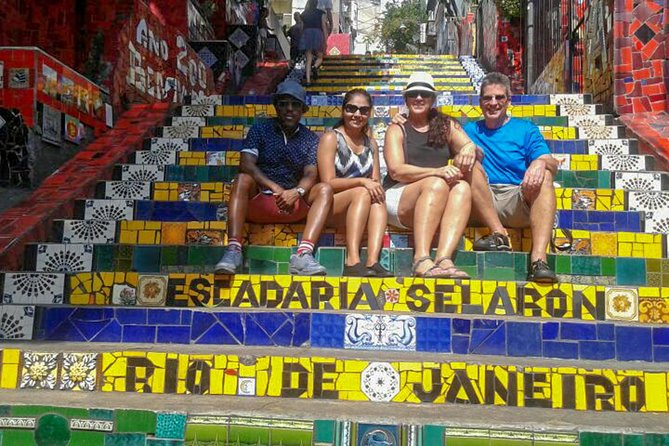
The Escadaria Selarón is one of the afternoon’s most enjoyable stops. Chilean artist Jorge Selarón covered all 215 steps with tiles collected in Rio and donated by people from around the world.
Many tiles are red, but the staircase is full of changing patterns, images, and small details. Selarón began the work in 1990, turning a neglected stairway between Lapa and Santa Teresa into a public artwork.
You get about 25 minutes here. That is enough to climb part of the staircase, photograph the tiled walls, and look for unusual tiles. The steps can be crowded, so do not expect a quiet artistic study. Watch your footing and keep your belongings secure while you take photographs.
This stop feels different from the major viewpoints. Christ and Sugarloaf show Rio from above. Selarón brings you down to street level, where the city’s creative energy is more personal and unpredictable.
The route also passes the Carioca Aqueduct, better known as the Lapa Arches. Since the late nineteenth century, the structure has carried a tram linking central Rio with Santa Teresa. The tour does not list a long stop there, so you should treat it as a drive-by sight or brief photo opportunity rather than a full visit.
Two churches, two very different Rio interiors
The Metropolitan Cathedral of Saint Sebastian is one of the tour’s best contrasts. Its cone-shaped form was inspired by the Mayan pyramids of Mexico, and four huge stained-glass windows rise from floor to ceiling, meeting in a cross near the top.
The outside can look severe and modern. Inside, the colored glass changes the mood completely. The cathedral is also known for strong acoustics, so take a quiet moment to notice how sound carries through the space.
The visit lasts about 20 minutes. That is enough to enter, see the windows, and hear the main points from the guide.
São Bento Monastery offers an entirely different experience. Founded in 1590 by monks from Bahia, the complex remains a place of silence and prayer. Visits are limited to the Church of Our Lady of Montserrat, but that church is filled with details, including rosewood altars covered in gold and an Art Nouveau iron gate.
I especially like having both churches on the same day. The cathedral shows twentieth-century modernism and dramatic scale. São Bento gives you ornate religious decoration and a quieter atmosphere. Neither stop is long, so you will not have time for a detailed art study, but together they make the city’s architectural contrasts easy to understand.
Beaches and neighborhoods from the vehicle
The tour begins around Copacabana Beach, one of Rio’s best-known stretches of sand. It also passes through Ipanema and Leblon, two neighborhoods in the South Zone.
Ipanema is linked worldwide with the bossa nova song The Girl from Ipanema. Leblon sits beside it, separated by a narrow canal, and is known as one of the city’s most exclusive areas.
These portions are mainly viewed during transfers rather than treated as long walking stops. That is useful for orientation, especially if you are visiting Rio for the first time. You see how the neighborhoods connect and how quickly the city shifts from beach life to hills and central districts.
If you have several days in Rio, I would return to these areas on foot. This tour gives you the overview, but not the time for a beach stroll, café stop, or slow look at street life.
How the guide and vehicle affect the day
The guide is central to the tour’s value. The strongest guiding style here is practical: clear meeting times, reminders about where to regroup, background stories without endless lectures, and help with photographs.
Guides named in feedback include Sabina, Monica, Victoria, Lucia, Meilin, Heraclito, Kiko, and Peter. Sabina is praised for calm organization and good English, while Victoria is noted for friendly time management. Lucia is described as especially effective at keeping the group moving through lines. Meilin is praised for fluent explanations and helping couples with photographs.
The van and driver matter just as much. Rio traffic can turn a short transfer into a slow one, and a careful driver reduces the strain of a long day. Pickup and drop-off also remove the need to navigate unfamiliar parts of the city after dark or between distant sights.
The group limit is 19 people. That is not a private tour, but it is more manageable than a large coach. You still need to accept some waiting and regrouping, especially at cable cars and the Corcovado vehicles.
Is $109.50 good value?
At $109.50 per person, the value depends on the option you select and how much of the day you use.
The base option gives you transport, a licensed multilingual guide, and the guided city route, but Christ the Redeemer and Sugarloaf tickets are excluded. If you add those admissions separately, the price difference between options becomes important.
The ticket-and-lunch choice is the simpler deal for most first-time visitors. It bundles the two major paid sights with the churrascaria meal and avoids handling admissions during a tightly planned day. It is also a better fit if you have only one day in Rio.
Independent visitors may spend less by using local transport and choosing fewer stops. But you would give up the hotel pickup, coordinated transfers, guide explanations, and help with queues and meeting points. I see the tour as a time-saving purchase rather than a bargain in the narrowest sense.
The tour is booked an average of 46 days ahead, which suggests that planning early is sensible, especially for peak dates. Free cancellation is available up to 24 hours before the start time, but late cancellations and late changes are not refunded or accepted.
Who should book this tour?
I recommend it most strongly for a first visit, a short stay, cruise passengers with one free day, solo visitors who want organized transport, and anyone who wants Rio’s major sights without managing several separate bookings.
It also suits people who want a safe, structured introduction before exploring independently. The tour gives you enough orientation to return later to Ipanema, Lapa, Copacabana, or the city center on your own.
I would hesitate if you dislike early starts, group schedules, short photo stops, or sitting in a vehicle between sights. It is also not ideal if your main goal is a long visit inside Maracanã, a slow afternoon at the beach, or detailed museum time.
Carnival requires extra flexibility. Road closures may remove some afternoon stops, though the Christ the Redeemer and Sugarloaf portions are stated to remain in place. The itinerary can also change because of traffic or other operating needs, and the tour requires a minimum number of participants to run.
The bottom line for a first day in Rio
Book this tour if you want to cover Rio’s essential sights in one organized, energetic day. I like the order of the route, the early mountain visits, the mix of famous views and less obvious city landmarks, and the strong attention to timing from the guides.
Choose the ticket-and-lunch option if you want the easiest experience and enjoy Brazilian barbecue. Choose the base option only after checking the separate cost of attraction admissions.
This is not a relaxed portrait of Rio. It is a fast, useful introduction that lets you see the city from Corcovado, Sugarloaf, its beaches, its Carnival venues, and its historic center before deciding where to spend more time.
FAQ
Where does the tour start?
The stated meeting point is the Hilton Rio de Janeiro Copacabana at Av. Atlântica, 1020. Pickup is also offered at selected hotels in Leme, Copacabana, Ipanema, and Leblon.
What time does the tour begin?
The start time is 7:30 am.
Are Christ the Redeemer and Sugarloaf tickets included?
They are included only in the option that includes admission tickets and lunch. The base option excludes both attraction admissions.
Is lunch included?
Lunch is included only in the option with tickets and lunch. It is a barbecue buffet at a steakhouse. Drinks and dessert are not included.
Does the tour enter Maracanã Stadium?
No. The tour makes a quick exterior stop near the Bellini statue for photographs. An interior stadium visit requires a separate tour.
Can the itinerary change during Carnival?
Yes. Road closures and traffic can lead to changes, particularly during the afternoon city portion. The visit to Christ the Redeemer and the Sugarloaf complex is stated not to be affected.
Just added in Rio de Janeiro
- Full Day Tour in Rio de Janeiro★ 5.0 · 8 reviews
- Garganta do Ceu Cave Hiking Private Tour on Pedra da Gavea★ 4.5 · 3 reviews
- Gastronomic Tour at the Municipal Market in Rio de Janeiro★ 5.0 · 4 reviews
- GIG Airport Transfer x Rio de Janeiro Hotels★ 4.5 · 11 reviews
- Rio de Janeiro private Full day Custom Tours★ 5.0 · 35 reviews
- Christ the Redeemer – Complete Morning Tour with Ticket and Transport at the Hotel★ 3.5 · 4 reviews
- AquaRio, Museum, Boulevard Olimpico, Ferris Wheel, Transport and Tourism Guide.★ 4.0 · 6 reviews
- Personalized and Private Full-Day Tour in Rio de Janeiro★ 5.0 · 6 reviews
Christ the Redeemer and Sugarloaf, compared.

Christ the Redeemer Entry Ticket by Corcovado Train
Read our review →
Rio’s City Tour – Tickets for Christ, Sugar Loaf & Lunch included
Read our review →
Full Day: Christ Redeemer, Sugarloaf, City Tour & Barbecue Lunch
Read our review →

Rio’s Full Day: Selarón Steps, Christ & Sugarloaf – Tickets & Lunch Included
Read our review →
Christ the Redeemer, Sugarloaf, Selaron & BBQ Lunch
Read our review →
The Best Half Day in Rio with Christ Redeemer and Sugar Loaf Hill
Read our review →
Full Day in Rio: Christ by Train, Sugarloaf, Selarón & Barbecue
Read our review →Browse the lists this tour appears in