
Reviewed · HISTORICAL TOURS
From the Past to the Present: A Historical Walking Tour of Rio
Rio’s past is hiding in plain sight. This four to five-hour walk links grand public buildings, colonial churches, bold street art, and Valongo Wharf, giving you a useful introduction to central Rio beyond the beaches and mountain views. Guide Bruno brings the route to life with stories, old photographs, local insight, and a clear sense of how the city changed over time.
I especially like the small group limit of 10 people, which should make it easier to ask questions and hear the guide in busy streets. I also like the route’s range: you move from Theatro Municipal and Brazil’s first public park to the Selarón Steps, São Bento Monastery, Kobra’s giant mural, and a site tied to the history of slavery.
The main thing to consider is the walking. The pace is spread across four to five hours, but central Rio can be hot, and some stops are brief. The Royal Portuguese Reading Room may have a long line, so you might only see its striking exterior. At $49.05 per person, this is best for you if you want context and conversation, not just a checklist of landmarks.
In This Review
- Key points before you book
- Why this walk gives Rio a useful first chapter
- Starting beneath Cinelândia’s grand buildings
- Passeio Público, Rio’s early public park
- Selarón Steps and the old aqueduct
- The Metropolitan Cathedral’s striking interior
- A possible short visit to the Royal Portuguese Reading Room
- Two churches, two views of Rio’s religious past
- From Mauá Square to Kobra’s giant mural
- Ending at Valongo Wharf
- What the $49.05 price buys you
- Who will enjoy this walk most
- Should you book From the Past to the Present?
- FAQ
- Where does the historical walking tour begin?
- What time does the tour start?
- How long does the tour last?
- Where does the tour end?
- How many people can join the tour?
- Can I cancel for a full refund?
Key points before you book
- Bruno makes history personal: His English, patience, local connections, and use of old now-and-then photographs add depth to the walk.
- A strong central Rio route: You move from Cinelândia through historic churches and public spaces toward the port district.
- The group has a maximum of 10 people: That is a useful size for questions and a more personal guide experience.
- The tour covers more than architecture: It connects Rio’s colonial past, urban growth, public art, religion, and the legacy of the slave trade.
- The Royal Reading Room is not guaranteed inside: Crowds and long lines can reduce the time available there.
- The finish at Valongo Wharf matters: This archaeological site gives the tour a serious and necessary final chapter.
Why this walk gives Rio a useful first chapter
Many first visits to Rio focus on Copacabana, Ipanema, Sugarloaf Mountain, and Christ the Redeemer. Those places are memorable, but they do not explain how Rio became the city you see today.
This walk takes you into Centro and the port area, where the city’s political, religious, artistic, and commercial stories come together. I like that the route does not treat history as a string of dates. It moves from elegant civic buildings to public parks, waterworks, churches, graffiti, and a site connected to enslaved Africans brought to Brazil.
Bruno appears to be the heart of the experience. His style is not just a speech delivered at each stop. He encourages questions, adjusts the discussion to your interests, and uses facts, stories, and comparisons between old Rio and present-day Rio. An especially useful touch is his book of vintage photographs, which helps you see how places looked before streets, hills, and neighborhoods changed.
The feedback about Bruno is unusually consistent. He is praised for his English, patience, humor, attention to detail, and ability to make Rio feel real rather than polished for tourists. One particularly useful point is that he made the four-hour walk manageable for a person who was six months pregnant. That does not mean the route is effortless, but it suggests a steady pace rather than a forced march.
More History Tours in Rio de Janeiro
- Rio de Janeiro Historical Center Walking Tour
★ 4.5 · 336 reviews - Private Walking and Cultural Tour Rocinha-Rio de Janeiro
★ 5.0 · 239 reviews - Discover Rio Little Africa: A Cultural and Historical Journey
★ 5.0 · 238 reviews
Starting beneath Cinelândia’s grand buildings
The meeting point is the Starbucks at Praça Floriano, 7, in Cinelândia. The walk begins at 8:30 in the morning, a sensible start for a route that may last until early afternoon.
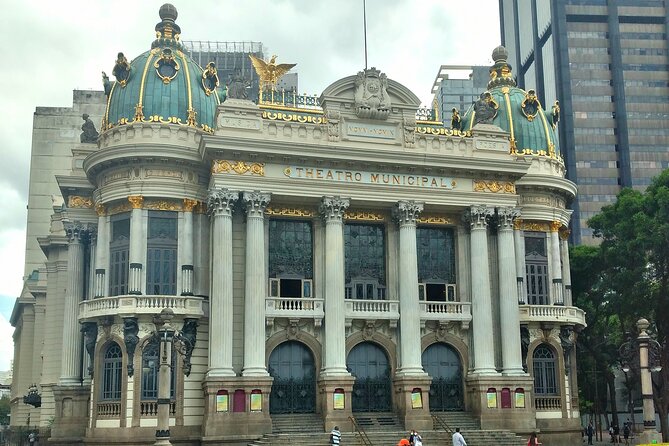
Cinelândia is one of the best places to begin because the architecture gives you an immediate sense of Rio’s civic ambitions. The area includes the Theatro Municipal, the Biblioteca Nacional, the Museu Nacional de Artes, and the former Supremo Tribunal Federal building. You get about 20 minutes here, enough for an introduction and an explanation of why this part of Centro matters.
The Theatro Municipal is especially important as a visual marker. Even if you do not enter, the exterior helps show the grand scale of Rio’s public institutions. The nearby library, art museum, and former court building add to the feeling that this was designed as a center of government, culture, and public life.
You should not expect long interior visits at every building. The value here comes from seeing the group of buildings together and hearing how they fit into Rio’s development. Keep your eyes up, but keep an eye on your belongings too. This is a city-center walking route, not a quiet museum campus.
Passeio Público, Rio’s early public park
From Cinelândia, the tour continues to Passeio Público, described as the first public park in Latin America. You spend about 30 minutes here, making it one of the longer stops.
That extra time makes sense. A park can look like a simple green pause on a walking route, but it also shows how a city changes its idea of public space. Here, Bruno can connect Rio’s early urban growth with the way people used shared areas for leisure, movement, and social life.
I like this stop because it breaks up the grand architecture. After looking at theaters, libraries, and courts, you get a chance to slow down and see Rio as a lived-in city. It also gives the guide room to explain change over time, one of the tour’s central themes.
The park is a good place to settle into the day. Wear shoes you can walk in for several hours, and carry water. The tour is not described as difficult, but the combination of distance, heat, and city pavement can wear you down if you arrive unprepared.
Selarón Steps and the old aqueduct
The route then reaches the Escadaria Selarón, one of Rio’s best-known public artworks. The staircase is about 125 meters long and decorated with more than 2,000 tiles. The planned stop lasts around 20 minutes.
The steps work well on this tour because they show a very different Rio from the formal buildings around Cinelândia. Here, color and personal expression take over. You will have time to look at the tile patterns, take photographs, and hear how this once-local project became an internationally recognized work of public art.
Twenty minutes is enough for a focused visit, though not enough to linger over every tile. If photography matters to you, be ready to move when the group moves. The staircase is a popular place, so the best experience comes from listening while you walk instead of waiting for perfect empty views.
Near the steps, the tour also passes an 18th-century water aqueduct. This old engineering work once supplied water to Rio and now carries the Bondinho de Santa Teresa. It is a fine example of how the city keeps using older structures in new ways.
That connection between past and present is one of the strongest ideas in the walk. The aqueduct is not treated as a dead monument. It remains part of Rio’s transport system, linking colonial engineering with modern city life.
More Walking Tours in Rio de Janeiro
- Rio de Janeiro: Rocinha Favela Walking Tour with Local Guide
★ 4.8 · 3,052 reviews - Rio De Janeiro: Half-Day Rocinha Favela Walking Tour
★ 4.7 · 2,272 reviews - 3 Hour Rocinha Favela Walking Tour with a Local Guide
★ 5.0 · 833 reviews - Favela Tour Rio de Janeiro – Vidigal Walking Tour by Russo Guide
★ 5.0 · 377 reviews
The Metropolitan Cathedral’s striking interior
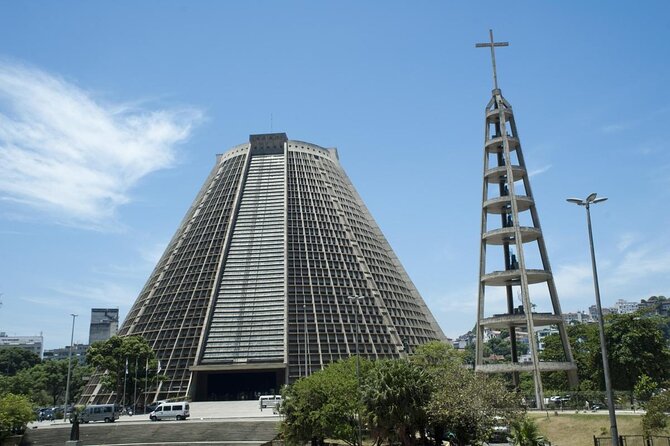
The Metropolitan Cathedral of Saint Sebastian receives about 20 minutes. It is described as a very unusual cathedral, and that is a fair warning not to expect a traditional European church exterior.
The cathedral’s shape and scale make it a sharp change from the older churches on the route. This is one of the places where a guide adds real value, since the building can be confusing if you simply walk in, look around, and leave.
The short stop should allow time to take in the design and hear why it differs from Rio’s colonial religious buildings. The experience is more about contrast than ceremony: modern religious architecture beside older churches, aqueducts, and civic structures.
Since the tour schedule is tight, you should not count on a long quiet visit. Treat this as an introduction, then let Bruno explain how the cathedral fits into the city’s changing identity.
A possible short visit to the Royal Portuguese Reading Room
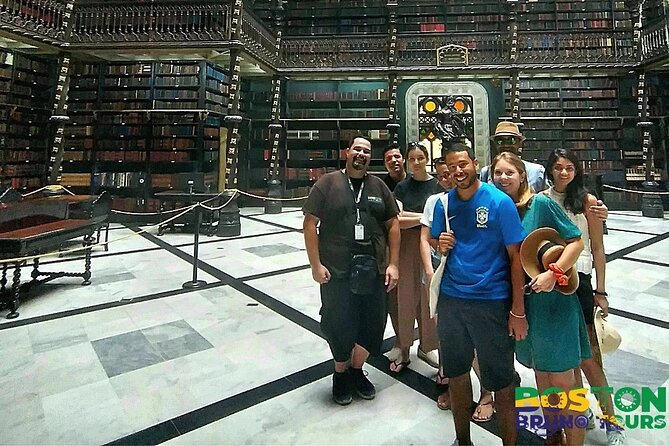
The Real Gabinete Português de Leitura, or Royal Portuguese Reading Room, is one of the most beautiful stops on the route. The planned visit is only 10 minutes, and that time may be reduced by long lines.
This is the one stop where you need to keep expectations in check. The room is famous for its ornate interior, but access can be crowded. If the line is too long, you may see only the outside so the tour can stay on schedule.
That limitation is worth knowing before you book. The building can be a highlight for anyone interested in books, architecture, or Portuguese culture, but it is not wise to treat the interior as guaranteed. The exterior still gives you a sense of the building’s importance, while Bruno can provide the context that a quick look cannot.
If this is a must-see for you, ask Bruno at the start how conditions look that morning. The supplied tour details do not promise entry or a set amount of indoor time.
Two churches, two views of Rio’s religious past
The walk includes a church identified as the São Francisco parish church, described as one of the city’s most beautiful and its second-largest temple. The stop lasts about 10 minutes.
That is a short visit, but churches reward careful looking. Notice the contrast between the church’s religious purpose and the surrounding city streets. This stop helps show how faith, colonial power, art, and daily life were closely connected in older Rio.
The route later reaches the Mosteiro de São Bento, or São Bento Monastery. You spend about 15 minutes there. Located on Morro de São Bento in central Rio, it is one of the city’s key colonial art monuments.
The monastery is an important counterpoint to the modern cathedral. Where the cathedral shows Rio’s later architectural imagination, São Bento takes you back to colonial religious art. The two stops together make the tour more than a collection of pretty buildings. They show how Rio’s religious spaces changed across time.
A 15-minute visit is enough for an introduction, but it will feel brief if you want to study every detail. The tour’s strength is breadth, so you should expect a series of focused stops rather than long museum sessions.
From Mauá Square to Kobra’s giant mural
After São Bento, the group passes through Mauá Square on the way to the famous Kobra graffiti. The mural is called Painel Etnias and is described as the largest graffiti work in the world.
The planned stop is only five minutes. That sounds short, but the scale of the mural gives you something to look at immediately. This is a quick photographic stop with a strong visual payoff.
Painel Etnias also fits the tour’s wider theme. You have already seen buildings tied to government, religion, literature, and water supply. Now you see modern public art in a port district that has changed dramatically. The mural brings present-day Rio into the story rather than ending with the colonial period.
Do not expect a long art lesson here. The stop is designed to show you the work and explain its place in the city. If you want detailed time with the mural, you may need to return independently.
Ending at Valongo Wharf
The tour ends at Cais do Valongo, or Valongo Wharf, on Avenida Barão de Tefé in Saúde. The scheduled stop is about five minutes, but its meaning is far greater than the time suggests.
Valongo Wharf was the main landing point and trading center for enslaved Africans brought to Brazil between 1811 and 1831. Today, it is an archaeological site with major historical and spiritual importance.
Ending here gives the route moral weight. Rio’s beauty and cultural energy cannot be separated from the violence and exploitation that helped shape Brazil. A tour that moves from theaters and churches to a former slave landing site asks you to see the city as a whole, not as a postcard.
The short stop may feel too brief for such a serious place. Still, its position at the end lets the earlier sites take on new meaning. The public buildings, churches, neighborhoods, and port all belong to one connected story.
The end point is not the same as the beginning. Plan your onward route from Saúde rather than assuming you will finish back in Cinelândia. The tour details only identify Cais do Valongo as the final stop.
What the $49.05 price buys you
At $49.05 per person, this is not the cheapest way to walk around Centro. You can see several sites from the street without paying an admission fee. The price makes more sense when you value interpretation, route planning, translation, and the chance to ask a local guide direct questions.
The maximum group size of 10 helps protect that value. A large group can turn a historical walk into a moving crowd, especially near the Selarón Steps and busy central streets. A small group gives Bruno a better chance to adjust the conversation and keep everyone involved.
You are also covering a route that would be hard to organize efficiently on your own. The stops are spread across different parts of central Rio, and their importance is not always obvious from the outside. Bruno’s use of old photographs and his explanations of how hills and neighborhoods changed can make the city easier to understand.
This is a good price for a first or second day in Rio if you want a framework for the rest of your visit. It is less attractive if you prefer to spend a full afternoon inside one museum or move at your own pace.
The tour is frequently booked well ahead, with an average booking time of 57 days. That suggests you should not leave it until the last minute if your dates are fixed.
Who will enjoy this walk most
I would choose this tour if you want Rio’s story explained in plain language and you enjoy stopping often for conversation. It should suit solo visitors, couples, families with older children, and people who want more than beaches and viewpoints.
The tour also fits people who have already visited the famous attractions and want a different side of the city. One useful strength is Bruno’s ability to respond to personal interests. If you ask about urban change, architecture, culture, or Rio’s past, the discussion may expand beyond the basic stop-by-stop plan.
Families may appreciate the mix of visual stops. Grand theaters, tiled stairs, a giant cathedral, churches, and a huge mural give younger visitors more variety than a museum-only tour. Still, the four to five-hour length requires patience.
You should think twice if you dislike walking, need guaranteed indoor access, or want long visits at each site. The route has short stops, and the Reading Room may be limited to an exterior view.
Most people can participate, and the tour is near public transportation. Good weather is required. If poor weather cancels the experience, you can receive a different date or a full refund.
Should you book From the Past to the Present?
Book it if you want to understand how Rio moved from colonial port to modern city, and if you value a guide who can connect famous landmarks with less obvious parts of the story. Bruno’s strong English, humor, patience, local contacts, and use of historical photographs are the main reasons this feels like more than a basic orientation walk.
The route is especially worthwhile early in your stay. It gives you context for Rio’s architecture, public art, churches, port district, and social history before you explore the city on your own.
Skip it if your priority is a relaxed stroll, guaranteed entry into the Royal Portuguese Reading Room, or extended time at each landmark. This is a brisk, idea-filled walk with some serious history at its center.
For most visitors who want to see Rio beyond the famous postcard views, the $49.05 price is fair. The strongest value is not the free admission at each stop. It is Bruno’s ability to connect the pieces and help you see the city as a living story.
FAQ
Where does the historical walking tour begin?
The tour begins at the Starbucks at Praça Floriano, 7, in Centro, Rio de Janeiro.
What time does the tour start?
The start time is 8:30 am.
How long does the tour last?
The experience lasts approximately four to five hours.
Where does the tour end?
The walk ends at Cais do Valongo on Avenida Barão de Tefé in Saúde, Rio de Janeiro.
How many people can join the tour?
The tour has a maximum of 10 participants.
Can I cancel for a full refund?
Yes. You can cancel at least 24 hours before the local start time for a full refund. Cancellations or changes made less than 24 hours before the start are not accepted for a refund.
Just added in Rio de Janeiro
- Full Day Tour in Rio de Janeiro★ 5.0 · 8 reviews
- Garganta do Ceu Cave Hiking Private Tour on Pedra da Gavea★ 4.5 · 3 reviews
- Gastronomic Tour at the Municipal Market in Rio de Janeiro★ 5.0 · 4 reviews
- GIG Airport Transfer x Rio de Janeiro Hotels★ 4.5 · 11 reviews
- Rio de Janeiro private Full day Custom Tours★ 5.0 · 35 reviews
- Christ the Redeemer – Complete Morning Tour with Ticket and Transport at the Hotel★ 3.5 · 4 reviews
- AquaRio, Museum, Boulevard Olimpico, Ferris Wheel, Transport and Tourism Guide.★ 4.0 · 6 reviews
- Personalized and Private Full-Day Tour in Rio de Janeiro★ 5.0 · 6 reviews
Historical Tours, compared.



Private Walking and Cultural Tour Rocinha-Rio de Janeiro
Read our review →
Discover Rio Little Africa: A Cultural and Historical Journey
Read our review →


Scenic Train ride to historical cities of Morretes and Antonina
Read our review →
Browse the lists this tour appears in