

Reviewed · RIO DE JANEIRO CITY TOURS
Pedicab Tour of the Historical City Centre in Rio De Janeiro
Rio’s old center rewards a slower look. This pedicab tour links grand theaters, colonial squares, Afro-Brazilian landmarks, street art, and the revived port area without asking you to cross downtown on foot in the heat. I especially like the small-group format, capped at eight people, and the easy pace, which leaves room for photos and questions. The main drawback is that many stops last only five or ten minutes, so this is a broad introduction rather than a series of full museum visits.
I also like the way the route mixes famous sights with places that explain Rio’s past, including Cais do Valongo and Pedra do Sal. Guides such as Michael, Carlos, and Fanny have tailored the route to families, repeat visitors, and cruise passengers, and Michael has helped with photos, bathroom breaks, and local suggestions. At $70.57 per person, the tour is not the cheapest way to see downtown, but it can be good value if you want to cover a lot of ground while avoiding a long, hot walk.
In This Review
- Key points to know before booking
- Why a pedicab works well in central Rio
- Cinelândia begins the story with grand public buildings
- Lapa combines old engineering with street life
- Political and imperial Rio around Praça Quinze
- Churches, culture, and the road to the port
- Olympic Boulevard and the stories behind the port
- Morro da Conceição finishes above the old port
- Price, group size, and what you really receive
- Who should choose this Rio pedicab tour?
- FAQ
- Where does the pedicab tour begin?
- Where does the tour end?
- How long does the experience last?
- How many people can join the tour?
- Are admission tickets included?
- Can the route be adjusted?
- What happens if the weather is poor?
- Should you book it?
Key points to know before booking
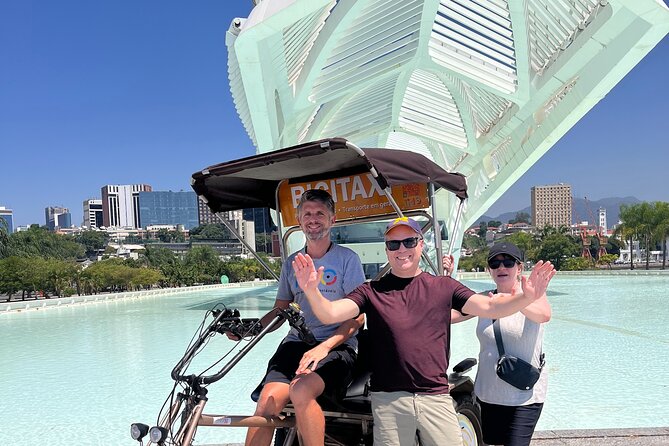
- Sixteen stops in about three and a half hours: You get a wide view of Centro, Lapa, Praça Quinze, and the port district.
- A relaxed pedicab ride: You can see the streets from an open seat, with less effort than a walking tour and more contact with daily city life than a sealed vehicle.
- Strong historical range: The route moves from Portuguese colonial buildings and imperial sites to slavery memorials, samba culture, modern art, and Olympic-era redevelopment.
- Exterior visits are common: Most stops are brief, and admission fees are not included at Theatro Municipal, Tiradentes Palace, Museu do Amanhã, or Rio Star.
- Flexible for families and repeat visitors: The route has been adjusted for children, grandparents, previous visits, and special interests.
- A weather-dependent experience: Poor weather can lead to a new date or a full refund, while cancellations made less than 24 hours ahead are not refunded.
Why a pedicab works well in central Rio

Rio’s historical center is compact on a map but tiring in practice. The route includes Lapa, Cinelândia, Praça Quinze, the waterfront, Saúde, and Morro da Conceição. Walking between all these areas would take time, energy, and attention that you could instead spend listening to the guide.
The pedicab offers a useful middle ground. You are close enough to hear street life and see building details, but you are not doing the work of covering every block yourself. One particularly nice detail is the open view from the rear seat. You can watch people react as the pedicab passes, something you simply do not get from a standard tour bus.
The ride is also a relief during Rio’s heat and humidity. A family with grandparents and children aged five and eight found that the bikes allowed everyone to cover more ground without spending the whole morning managing tired children. The guide also made time for water and bathroom breaks. That kind of practical care matters more than a long list of dates.
The tradeoff is space and exposure. A pedicab is not a private car, and the tour runs outdoors. You should expect sun, traffic noise, and the normal movement of downtown Rio. The open format is part of the appeal, but a rainy day can spoil it.
More History Tours in Rio de Janeiro
- Rio de Janeiro Historical Center Walking Tour
★ 4.5 · 336 reviews - Private Walking and Cultural Tour Rocinha-Rio de Janeiro
★ 5.0 · 239 reviews - Discover Rio Little Africa: A Cultural and Historical Journey
★ 5.0 · 238 reviews
Cinelândia begins the story with grand public buildings
The usual meeting point is Praça Floriano, beside the Municipal Theater of Rio de Janeiro. This is a sensible place to begin because Cinelândia brings several important buildings together within a short distance.
Theatro Municipal is the architectural star. Its design draws on the Paris Opera House, and even a ten-minute stop gives you time to appreciate the grand facade and its place along Rio’s first major avenue. Admission is not included, so this part of the tour is an exterior introduction rather than a theater visit.
Nearby, the Palácio Pedro Ernesto houses Rio’s Municipal Chamber. Its columns, sculpture, and neoclassical design show how much civic pride went into the city center in the early 20th century. The building opened in 1923 and remains tied to local government. You can see it without paying an admission fee, though the planned stop is only five minutes.
Amarelinho da Cinelândia adds a social and culinary note. This long-established bar and restaurant is a local meeting place, known for Brazilian dishes and drinks. Five minutes is not enough for a meal, but the stop helps explain how the square functions beyond its monuments. If you want to return later, it is a useful place to mark on your map.
Lapa combines old engineering with street life
The route then heads toward the Arcos da Lapa, also called the Carioca Aqueduct. Its 42 arches stretch more than 270 meters and date to the 18th century, when the structure carried water from the Carioca River toward the city center.
Later, the aqueduct became a track for the Santa Teresa tram. That change tells a neat story about Rio adapting old infrastructure to a new city. Today, the arches are one of Lapa’s best-known sights and a gateway to the neighborhood’s evening bars and music venues.
The five-minute stop is brief, so do not expect a full history lecture on site or time to explore the surrounding streets. Still, the pedicab makes this kind of quick look easy. You can pause, take a photograph, and continue without the long approach required on foot.
Escadaria Selarón deserves a little more time, with a planned fifteen-minute stop. Chilean artist Jorge Selarón covered the 215 steps with more than 2,000 tiles from over 60 countries. The colors and small details reward a close look, but the staircase is also a place where you may want to walk a few steps yourself.
The pedicab gets you close, but it cannot replace the experience of standing among the tiles. This is one point where the tour’s broad coverage has a limit. You receive a strong introduction and a photo opportunity, but you may want to return if the staircase is a priority.
Political and imperial Rio around Praça Quinze

The Palácio Tiradentes is another grand neoclassical building, completed in 1926. It first served as Brazil’s Chamber of Deputies and now houses the Legislative Assembly of the State of Rio de Janeiro. Its name honors Tiradentes, a national figure associated with Brazil’s independence movement.
The five-minute stop is enough to see the facade and hear why the building matters. Admission is not included, so check your expectations. This tour is built around seeing and understanding the exterior, not spending long periods inside each landmark.
Paço Imperial changes the mood. This colonial building began as a residence for Portuguese governors and later served as a royal and imperial palace. Its Baroque and neoclassical elements, courtyards, and grand rooms reflect the period when Rio was the center of Portuguese and Brazilian power.
Admission is free, and the building now functions as a cultural center with exhibitions, concerts, and other events. The scheduled five minutes gives you a quick look, but you may wish to return independently if an exhibition catches your eye.
Praça Quinze de Novembro brings several layers together. The route enters the Telles Arch, an 18th-century passage leading into a narrow alley lined with bars and restaurants. The lane has a colonial feel and gives you a sense of how old Rio survives inside a working city.
You also get a view toward Guanabara Bay and Fiscal Island palace, along with the site of the old municipal market. The ten-minute stop is short, yet this is one of the route’s better places for connecting buildings, waterfront views, and everyday city use.
More Rio city tours:
- Rio’s City Tour – Tickets for Christ, Sugar Loaf & Lunch included
★ 5.0 · 4,389 reviews - Full Day: Christ Redeemer, Sugarloaf, City Tour & Barbecue Lunch
★ 4.5 · 3,142 reviews - Rio: Christ the Redeemer, Sugarloaf, Selaron & BBQ Lunch
★ 4.5 · 2,428 reviews - A Day in Rio – City Tour
★ 4.5 · 1,128 reviews
Churches, culture, and the road to the port
The Centro Cultural Banco do Brasil occupies a neoclassical building from 1906 that once served as a bank. Today it presents exhibitions, theater, films, and educational programs. The ten-minute visit is free and lets you appreciate both the former bank interior and the institution’s role in Rio’s arts scene.
You may not have time to attend an event, but the stop shows how old commercial buildings can gain a new public purpose. It is also a practical place to note for a later visit during your stay.
The Church of Our Lady of the Candelaria is one of the tour’s most impressive religious landmarks. Construction began in the late 18th century and continued into the 19th century, producing a mix of Baroque, neoclassical, and Renaissance influences.
The facade is detailed, while the interior contains paintings, sculpture, and a large altar. The church is also linked to major national events, including the Proclamation of the Republic in 1889. Ten minutes gives you a worthwhile look, although anyone interested in church art will probably want more time.
The Museu do Amanhã marks a sharp turn toward modern Rio. Santiago Calatrava designed the futuristic science museum, whose structure and sustainable features are attractions in their own right. You will circle the perimeter rather than enter, but the outside offers good angles for photographs and views along the waterfront.
This is an important expectation to set before booking: the museum admission is not included because the tour does not visit the galleries. If you want the exhibits, plan a separate visit and use the pedicab drop-off as a starting point.
Olympic Boulevard and the stories behind the port
The Painel Etnias is a large mural by Brazilian artist Eduardo Kobra. At 170 meters long, it shows faces representing Indigenous peoples from five continents. The strong colors make it easy to spot, but the subject gives the mural more weight than a simple photo backdrop.
The ten-minute stop works well for photographs and a short explanation of its message about human diversity and unity. It is one of the route’s clearest examples of contemporary public art.
At the end of Olympic Boulevard, you pass the Rio Star, the giant observation wheel, and the aquarium attractions. The stop lasts about five minutes, and you will not ride the wheel during the tour. If you decide to return, the operator says a discount on Rio Star admission may be available through its partnership.
Cais do Valongo is a much more serious stop. This archaeological site was the main landing port for enslaved Africans brought to the Americas during the 19th century. It was uncovered during redevelopment in 2011 and became a UNESCO World Heritage Site in 2017.
The remaining stones and artifacts make the site a place for quiet reflection. Ten minutes cannot cover the full history of the transatlantic slave trade or Brazil’s long use of enslaved labor, but the stop ensures that the port district is not presented only as a new entertainment zone.
Pedra do Sal adds another layer of Afro-Brazilian life. The site was connected to the salt trade and to communities of enslaved Africans and their descendants. It is now known for samba gatherings, street art, and Afro-Brazilian cultural expression.
The ten-minute stop may not coincide with a samba gathering, but it explains why this small area matters. I like that the route places Pedra do Sal after Cais do Valongo. The sequence connects forced migration, community, music, and cultural survival without reducing the story to a few decorative buildings.
Morro da Conceição finishes above the old port
Morro da Conceição is a historic hill in Saúde with narrow cobbled streets, older houses, churches, and a slower feel than the avenues below. Its Conceição Fort dates to the 18th century and offers views across the surrounding area.
The hill is also home to art studios, galleries, and local cultural events. The ten-minute visit normally ends near a corner with Italian, Mexican, and traditional Brazilian restaurants. That is a useful finish because you can continue the afternoon with lunch instead of rushing straight back to sightseeing.
The pedicab returns to the starting point at the Municipal Theater. The full route takes about three and a half hours, though the exact pace can change when the guide adjusts stops to match your interests.
Price, group size, and what you really receive
At $70.57 per person, this is best judged against the amount of ground covered and the cost of your time. You are not paying for entry to a string of museums. You are paying for transport through a spread-out district, a guide’s narration, the ability to stop often, and a gentler way to see places that are awkward to combine independently.
The value improves if you are visiting for a short time, arriving by cruise ship, traveling with older relatives, or visiting with children. It also makes sense on a second trip to Rio, when you have already seen the main beach sights and want to understand Centro.
The maximum group size is eight, which keeps the experience smaller than a bus tour. Some outings have been adapted around what the group had already seen, adding new places or changing the order. You should discuss special requests before the ride, since flexibility is one of the tour’s strongest features.
The meeting point is Praça Floriano at the Municipal Theater. One booking included pickup and return to a cruise port, but that was arranged directly, so you should confirm any port transfer rather than assume it comes with the standard tour.
The activity is near public transport, service animals are allowed, and most people can participate. The pedicab reduces walking, but it does not remove it completely. Escadaria Selarón, church interiors, arches, squares, and waterfront stops all work best if you can get on and off and walk a short distance.
Book ahead if your schedule is fixed. This experience is often reserved about 40 days before the date, suggesting that popular departure times can fill early. Free cancellation is available until 24 hours before the start time. A cancellation inside that window is not refunded, and poor weather may lead to a new date or a full refund.
Who should choose this Rio pedicab tour?
I would choose it for a first look at central Rio, especially if you want history without committing to a long walking tour. It suits solo visitors, couples, families, and small groups, and the examples of three-generation families are persuasive.
It is also a good fit for anyone who prefers stories to a checklist. The guide can explain why a theater, aqueduct, palace, slave port, samba site, and modern museum belong in one route. Michael’s style has been praised for using stories rather than only dates, and for offering local tips and photo help.
I would be more cautious if your main goal is extended interior visits. The route gives you only a few minutes at many places, and several admission tickets are excluded. If you want to tour Theatro Municipal, Museu do Amanhã, or Rio Star, treat this as a first pass and schedule extra time afterward.
FAQ
Where does the pedicab tour begin?
It begins at the Municipal Theater of Rio de Janeiro, at Praça Floriano, S/N, Centro, Rio de Janeiro.
Where does the tour end?
The activity ends back at the meeting point by the Municipal Theater.
How long does the experience last?
The tour lasts approximately three hours and thirty minutes.
How many people can join the tour?
The maximum group size is eight people.
Are admission tickets included?
Admission is not included for Theatro Municipal do Rio de Janeiro, Tiradentes Palace, Museu do Amanhã, or Rio Star. Several other stops are listed as free, and this tour does not enter the Museu do Amanhã or Rio Star.
Can the route be adjusted?
Yes. The route has been changed for groups that had already seen certain places, and guides have adjusted stops for family needs and personal interests.
What happens if the weather is poor?
The experience requires good weather. If it is canceled because of poor weather, you will be offered another date or a full refund.
Should you book it?
Book this pedicab tour if you want to cover central Rio efficiently, hear clear stories, and keep walking to a manageable level. Its best qualities are the relaxed pace, small group, flexible routing, and thoughtful route from colonial power to Afro-Brazilian culture and the modern port.
Skip it if you want long museum visits or a deep look at every monument. For most people, though, $70.57 buys a useful and enjoyable orientation to a part of Rio that is easy to miss. It is an especially smart choice for cruise passengers, families, repeat visitors, and anyone who would rather watch the city pass by than sweat through every block.
Just added in Rio de Janeiro
- Full Day Tour in Rio de Janeiro★ 5.0 · 8 reviews
- Garganta do Ceu Cave Hiking Private Tour on Pedra da Gavea★ 4.5 · 3 reviews
- Gastronomic Tour at the Municipal Market in Rio de Janeiro★ 5.0 · 4 reviews
- GIG Airport Transfer x Rio de Janeiro Hotels★ 4.5 · 11 reviews
- Rio de Janeiro private Full day Custom Tours★ 5.0 · 35 reviews
- Christ the Redeemer – Complete Morning Tour with Ticket and Transport at the Hotel★ 3.5 · 4 reviews
- AquaRio, Museum, Boulevard Olimpico, Ferris Wheel, Transport and Tourism Guide.★ 4.0 · 6 reviews
- Personalized and Private Full-Day Tour in Rio de Janeiro★ 5.0 · 6 reviews
Rio de Janeiro City Tours, compared.

Rio’s City Tour – Tickets for Christ, Sugar Loaf & Lunch included
Read our review →
Full Day: Christ Redeemer, Sugarloaf, City Tour & Barbecue Lunch
Read our review →
Christ the Redeemer, Sugarloaf, Selaron & BBQ Lunch
Read our review →
São Paulo’s Full Day City Tour: Main City Sights in 7 Hours – (Shared Group)
Read our review →


Pub Crawl in Lapa with Cachaça Tasting and Live Samba
Read our review →
Rio’s Best_Corcovado, Sugar Loaf, Selaron, Cathedral and more
Read our review →Browse the lists this tour appears in