
Reviewed · RIO DE JANEIRO CITY TOURS
Rio’s city walking tour: a glimpse of history and olympic legacy
Rio’s past is hiding in plain sight. This four-hour outing gives you a useful introduction to downtown Rio, where narrow streets, imperial buildings, grand churches, museums, and busy market lanes tell a very different story from the beaches. I especially like the visits to São Bento Monastery, with its gilded carvings and paintings, and Praça XV, the former stage for Brazil’s emperors. The included hotel pickup also takes away some of the guesswork of reaching central Rio.
The main drawback is that the tour is not always as walk-heavy as its name suggests. Traffic can eat into the sightseeing time, and one account describes a long stop at a tea shop that replaced time on foot. At $60.77 per person, the price makes the most sense if you value a guide, hotel transport, and historical context rather than simply checking off landmarks.
In This Review
- Key points to know before booking
- Why this is a useful first or second day in Rio
- Candelária Church: a grand opening scene
- São Bento Monastery: the tour’s strongest interior
- Mauá Square and Rio’s Olympic-era makeover
- Praça XV and Paço Imperial: where Rio’s rulers worked
- Uruguaiana Street, market lanes, and everyday downtown
- Tiradentes Palace and Confeitaria Colombo
- The Metropolitan Cathedral: a striking finish
- What the guides add, and where the risk lies
- Is $60.77 a fair price?
- Walking level, timing, and useful preparation
- Who should book this Rio walking tour?
- FAQ
- How long does the Rio city walking tour last?
- What time does the tour start?
- Does the tour include hotel pickup and drop-off?
- What places are visited?
- Are food and drinks included?
- How large can the group be?
- How much walking is involved?
- Can I cancel for a refund?
Key points to know before booking
- São Bento Monastery is the artistic highlight: Allow yourself time to look up at the paintings and gold-covered carving.
- Downtown Rio comes with imperial history: Praça XV and Paço Imperial connect the modern city to Portuguese rule and Brazil’s nineteenth-century monarchy.
- The Olympic legacy is part of the route: Mauá Square, the Museum of Tomorrow, the Rio Art Museum, and the Cobra murals show a newer side of central Rio.
- The tour mixes walking with vehicle transfers: Heavy traffic has occasionally reduced the time spent on foot.
- Guide quality matters: André, Melanie, and Jean-Baptiste, often called JB, have received warm praise for their energy, flexibility, and local knowledge, though one guide was criticized for rushing and using a phone.
- Book it early if your dates matter: It is often reserved about eight days ahead, and the tour can be canceled if too few people sign up.
Why this is a useful first or second day in Rio
I like this tour best as an early visit, before you have fixed ideas about Rio’s layout. It links the historic center’s main points in one afternoon and gives you a sense of how downtown relates to the neighborhoods where most visitors stay.
You are picked up at your hotel around 1:00 p.m. The listed pickup areas cover most hotels in São Conrado, Leblon, Ipanema, and Copacabana. The group can reach as many as 35 people, although several departures have been much smaller, with some becoming private tours when only one or two people booked.
That smaller-group possibility changes the experience. Guides such as JB have adjusted the route when a group had already seen certain places, while another guide added sights to match a couple’s interests. You should not count on a private tour, but it is worth telling the guide what you care about at the start.
The tour is sold as lasting about four hours. The schedule can stretch or shrink because of traffic, group size, and the amount of time spent at each stop. One detailed account described a longer outing, while another found that traffic led to more driving and less walking. Think of the timing as a useful framework, not a stopwatch.
More History Tours in Rio de Janeiro
- Rio de Janeiro Historical Center Walking Tour
★ 4.5 · 336 reviews - Private Walking and Cultural Tour Rocinha-Rio de Janeiro
★ 5.0 · 239 reviews - Discover Rio Little Africa: A Cultural and Historical Journey
★ 5.0 · 238 reviews
Candelária Church: a grand opening scene
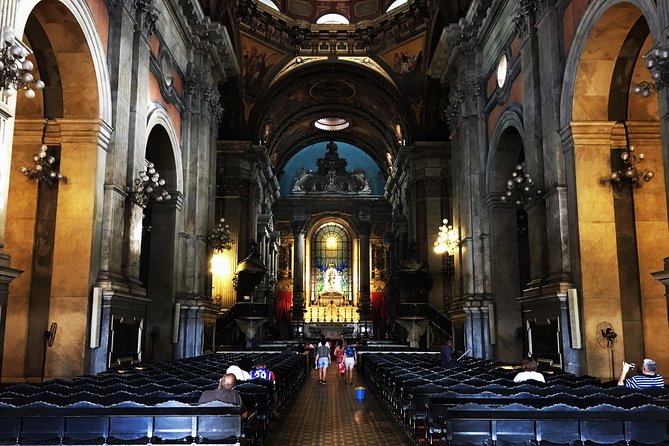
The Church of Our Lady of Candelária, or Igreja de Nossa Senhora da Candelária, is one of the first major stops. Construction began in 1630 and was completed in 1775, so the building carries several generations of Rio’s development in its walls.
The church’s neoclassical design gives the tour a strong start. You get a sense of the scale and ceremony favored by colonial religious institutions, and your guide can explain how the church fits into the city’s Portuguese and Catholic past.
The listed visit is brief, about 10 minutes, with admission included. That is enough for a quick look, but not for a long, quiet inspection of every detail. If church interiors are a main reason you book, pay close attention and ask your guide questions while you are inside.
Candelária is also a useful reminder that downtown Rio is not just a modern business district. Colonial and imperial monuments sit close to office towers, roadways, museums, and market streets. That contrast is one of the pleasures of the walk.
São Bento Monastery: the tour’s strongest interior
For many visitors, São Bento Monastery is the high point. Founded in 1590 by two monks from Bahia, it is regarded as one of Brazil’s important architectural treasures.
The exterior can seem restrained compared with the interior. Inside, the paintings and gilt wood carving create the kind of richly decorated church setting that rewards a slow look. Several people have singled out the Benedictine chapel and its artwork, and I can see why. This is the stop where a guide adds real value, since the visual details are easy to miss if you only step in, take a photo, and leave.
The scheduled visit is about 10 minutes and admission is included. That is short for such an ornate place, so use the time well. Look above eye level, notice the layering of paint and carving, and ask about the monastery’s age and role in Brazilian religious life.
São Bento also gives you an excellent view toward the newer waterfront district and the Museum of Tomorrow. One guide, JB, pointed out that angle for a memorable photograph. It is a fine example of what a good local guide can do: connect two parts of Rio that seem centuries apart.
Mauá Square and Rio’s Olympic-era makeover
The route then shifts toward the waterfront and the new Mauá Square. The square is described as part of Rio’s Olympic legacy, and its redevelopment helped create a new center for culture and entertainment.
Here you may see the Rio Art Museum, the Museum of Tomorrow, and the large Cobra murals. These attractions give the tour a modern counterpoint to the churches and royal buildings. You are not only looking at old Rio. You are also seeing how the city tried to reshape its waterfront and draw people back toward the center.
The Museum of Tomorrow is viewed from the outside. Its bold modern design is easy to contrast with the Portuguese-era buildings visited earlier. The tour does not present this as a full museum visit, so you should plan another time if you want to go inside.
The route also includes one of Rio’s important cultural centers. The exact amount of time here can depend on the guide and the day’s pace. Past departures have included a visit to an old Portuguese library building, which several people considered the most impressive stop. Since the schedule can vary, ask at the beginning if the library is part of your route.
More Walking Tours in Rio de Janeiro
- Rio de Janeiro: Rocinha Favela Walking Tour with Local Guide
★ 4.8 · 3,052 reviews - Rio De Janeiro: Half-Day Rocinha Favela Walking Tour
★ 4.7 · 2,272 reviews - 3 Hour Rocinha Favela Walking Tour with a Local Guide
★ 5.0 · 833 reviews - Favela Tour Rio de Janeiro – Vidigal Walking Tour by Russo Guide
★ 5.0 · 377 reviews
Praça XV and Paço Imperial: where Rio’s rulers worked
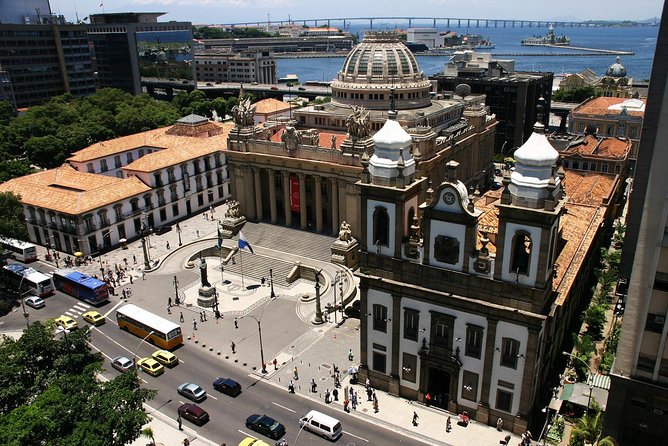
Praça XV de Novembro is one of the most meaningful public spaces on the route. Brazil’s emperors were crowned here in the 1800s, and the square witnessed other major events in the country’s political life.
The square works best when your guide supplies the timeline. Without context, it can look like another open space in central Rio. With the story of royal arrivals, imperial ceremonies, and changing government, the buildings around it become easier to read.
The Portuguese-style Paço Imperial is next. Built in the 1700s as a residence and workplace for Brazil’s rulers, it later served as a home for the Portuguese royal family after it arrived in Brazil. That detail gives the building unusual importance. It is not simply an attractive colonial structure. It reflects the moment when Portugal’s court moved across the Atlantic and Rio became the center of a monarchy.
The tour lets you see this setting as part of a larger city walk rather than as an isolated monument. You move between religious authority, royal power, commerce, and modern cultural projects. That broad mix is the real subject of the afternoon.
Uruguaiana Street, market lanes, and everyday downtown
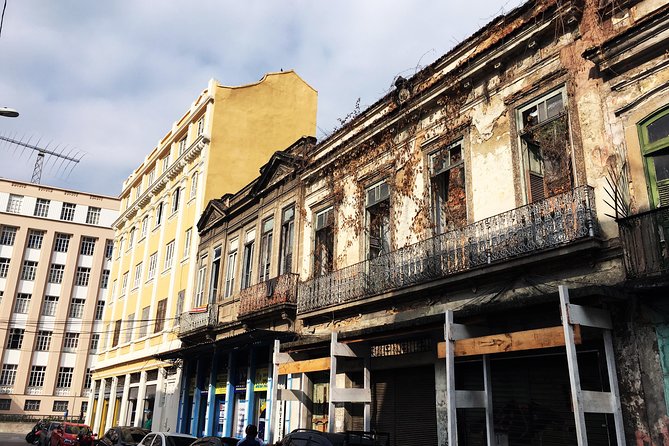
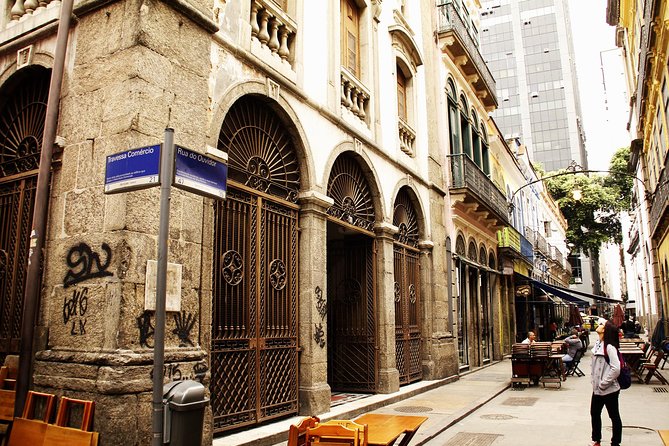
The walk continues along Uruguaiana Street, through famous market streets in Rio’s downtown. This section helps break up the formal parade of churches, palaces, and museums.
You get a closer look at the working side of the center, with shops and street commerce replacing grand façades. The route is useful for understanding how people use downtown today, not only how rulers used it centuries ago.
This is also where you may want more free time than the standard schedule allows. One person specifically wished for more walking and about 10 minutes to browse. If shopping or street life interests you, tell your guide. The pace has been flexible on some departures, but you should not assume a long independent wander.
The tour can feel less satisfying if traffic or vehicle transfers interrupt this part. The stated experience is a walking tour, but the actual balance can change. A guide who keeps the group moving on foot will give you more of the atmosphere that makes central Rio worth seeing.
Tiradentes Palace and Confeitaria Colombo
The route passes the Tiradentes Palace from outside. Its importance is mainly historical and civic, so this is a quick exterior view rather than a full visit.
A more leisurely pause comes at Confeitaria Colombo, Rio’s famous bakery and café. The scheduled stop is about 20 minutes, and food and drinks are not included. You can admire the setting, have something if you wish, or simply use the stop as a rest during the afternoon.
This is a pleasant break, but it is also one place where priorities differ. One account felt that a long tea-shop visit took time away from seeing more streets. If you would rather keep walking, ask how long the stop will be before settling in.
You will also find practical food advice around the cathedral and nearby markets. A local guide may point you toward less touristy places for lunch or snacks, though lunch itself is not part of this tour. Since this excursion begins at 1:00 p.m., eat beforehand or plan to buy something during the afternoon.
The Metropolitan Cathedral: a striking finish
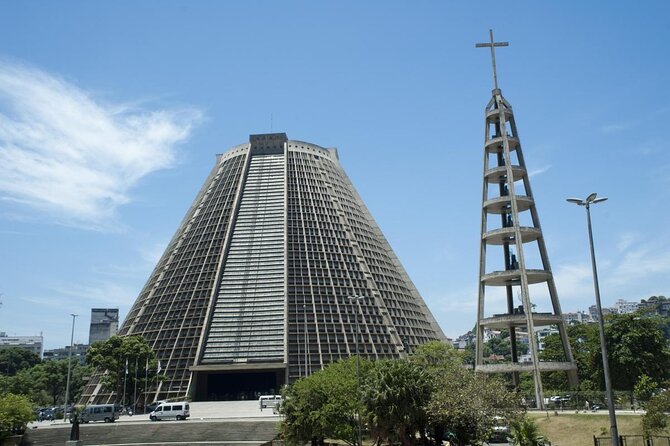
The final major sight is the Metropolitan Cathedral of Saint Sebastian, the enormous conical church often called Rio’s Metropolitan Cathedral. Its internal diameter is listed as 96 meters, with an external diameter of 106 meters and an overall height of 75 meters.
The shape is unlike the earlier churches. Candelária and São Bento look back to European religious design, while the cathedral presents a huge modern form. That contrast gives the route a satisfying visual ending.
The scheduled visit lasts about 10 minutes, admission is included, and the tour concludes in the Carioca Square area. Some descriptions also refer to the cathedral as the endpoint, so listen for the exact finishing point from your guide. You can continue exploring downtown on your own afterward, or use the return transfer if it is arranged for your departure.
One account noted that the tour ended a block short of the cathedral and Teatro Municipal. That may have been a specific routing issue, but it is a useful reminder to confirm where you will finish if those buildings matter to you.
What the guides add, and where the risk lies
The best accounts give special credit to guides who bring Rio to life through stories rather than just naming buildings. JB, short for Jean-Baptiste or Juan Bautista, is repeatedly praised for his energy, clear English, passion for the city, and ability to explain sights during the transfers as well as the walk.
Melanie, also spelled Malenia in some accounts, is praised for her friendly manner, language flexibility, and willingness to offer suggestions for the rest of a Rio visit. André was noted for arriving on time, paying close attention to the group, and changing the route around the visitors’ plans.
This flexibility is especially useful if you take the tour early in your stay. Ask about local markets, places to return to, and ways to save money. A good guide can turn a general introduction into a practical orientation for the rest of your trip.
The experience is not risk-free. One person found the guide distracted by texting and eager to finish. Another reported confusion involving the pickup vehicle, the wrong hotel, and conflicting information between the booking company and the local operator. These appear to be exceptions rather than the usual pattern, but you should wait in the hotel reception area if you are meeting at a hotel where you do not stay. One guide specifically advised that the driver or guide may look inside reception rather than outside.
The overall score is 4.3 from 78 ratings, which fits the picture: mostly strong guiding and worthwhile sights, with occasional problems involving pace, traffic, or communication.
Is $60.77 a fair price?
At $60.77 per person, this is not the cheapest way to see downtown Rio. You are paying for hotel pickup and drop-off, a guide, a planned route, and entry to the listed churches and monuments where admission is free.
The value is strongest if you are staying in Copacabana, Ipanema, Leblon, or São Conrado and do not want to work out transport to central Rio. It is also good value when the group is small and the guide adapts the route to your interests.
The value drops if you mainly want a long, independent walk. Food and drinks cost extra, and the tour may spend meaningful time in a vehicle when traffic is bad. Someone already comfortable navigating downtown, or someone focused on museums rather than exteriors, may prefer to arrange a local walk and pay separately for museum entry.
You should also remember that the maximum group size is 35. That is large enough to make questions and street crossings less personal. The small-group departures described above are appealing, but they cannot be guaranteed.
Walking level, timing, and useful preparation
The activity calls for moderate physical fitness. You will walk through central streets and historic areas, with time spent standing inside churches and at outdoor sights. One detailed account praised the pace but warned that the route involves a lot of walking, while another described it as an easy walk. Your experience may depend on traffic, the group, and how much the guide adds.
Wear comfortable shoes and bring water. Those are sensible choices for any four-hour city walk, especially one that shifts between indoor monuments and open streets. Since lunch is not included and the start is at 1:00 p.m., eat before pickup or budget for a purchase at Confeitaria Colombo or elsewhere.
The tour requires good weather. If poor weather cancels it, you are offered another date or a full refund. The company also requires a minimum number of participants, so a departure can be canceled if too few people book. Free cancellation is available up to 24 hours before the start time. A cancellation inside that window is not refunded.
Who should book this Rio walking tour?
I would choose it for a first or second day in Rio if I wanted a broad introduction without arranging downtown transport myself. It suits people who enjoy churches, architecture, city history, and a guide who can connect the sites to modern Rio.
It is also a good fit for couples, friends, and solo visitors who appreciate an adjustable route. Ask for JB, Melanie, or André if you are able to request a guide, but understand that a specific person cannot be promised.
I would skip it if your priority is a slow, unstructured stroll, extended museum visits, or a guaranteed private experience. The route can feel hurried in a large group, and traffic may cut into the walking portion.
For most first-time visitors, though, the combination of São Bento’s ornate interior, Praça XV, Paço Imperial, the Olympic-era waterfront, Confeitaria Colombo, and the Metropolitan Cathedral gives you a useful map of Rio’s center. Book it if you want orientation and context. Just confirm the pickup details, ask how much walking is planned, and tell the guide what you want to see before the route gets underway.
FAQ
How long does the Rio city walking tour last?
The tour lasts approximately four hours, though the actual timing can vary because of traffic, group size, and the pace of the visits.
What time does the tour start?
The listed start time is 1:00 p.m.
Does the tour include hotel pickup and drop-off?
Yes. Pickup and drop-off are included for most hotels in São Conrado, Leblon, Ipanema, and Copacabana.
What places are visited?
The route includes Candelária Church, São Bento Monastery, Mauá Square, the Museum of Tomorrow from the outside, a major cultural center, Praça XV de Novembro, Paço Imperial, downtown market streets, Tiradentes Palace from the outside, Confeitaria Colombo, and the Metropolitan Cathedral.
Are food and drinks included?
No. Food and drinks are not included. Confeitaria Colombo is visited, but anything you purchase there costs extra.
How large can the group be?
The maximum group size is 35 people. Some departures may be much smaller, depending on bookings.
How much walking is involved?
You should have a moderate level of physical fitness. The tour includes walking through downtown streets and standing at several historic sites, although traffic can sometimes reduce the walking time.
Can I cancel for a refund?
You can cancel up to 24 hours before the start time for a full refund. Cancellations made less than 24 hours ahead are not refunded. If bad weather or too few bookings cancel the tour, you are offered another date or a full refund.
More Rio City Tours
- Rio’s City Tour – Tickets for Christ, Sugar Loaf & Lunch included
★ 5.0 · 4,389 reviews - Full Day: Christ Redeemer, Sugarloaf, City Tour & Barbecue Lunch
★ 4.5 · 3,142 reviews - Rio: Christ the Redeemer, Sugarloaf, Selaron & BBQ Lunch
★ 4.5 · 2,428 reviews - A Day in Rio – City Tour
★ 4.5 · 1,128 reviews
Just added in Rio de Janeiro
- Full Day Tour in Rio de Janeiro★ 5.0 · 8 reviews
- Garganta do Ceu Cave Hiking Private Tour on Pedra da Gavea★ 4.5 · 3 reviews
- Gastronomic Tour at the Municipal Market in Rio de Janeiro★ 5.0 · 4 reviews
- GIG Airport Transfer x Rio de Janeiro Hotels★ 4.5 · 11 reviews
- Rio de Janeiro private Full day Custom Tours★ 5.0 · 35 reviews
- Christ the Redeemer – Complete Morning Tour with Ticket and Transport at the Hotel★ 3.5 · 4 reviews
- AquaRio, Museum, Boulevard Olimpico, Ferris Wheel, Transport and Tourism Guide.★ 4.0 · 6 reviews
- Personalized and Private Full-Day Tour in Rio de Janeiro★ 5.0 · 6 reviews
Rio de Janeiro City Tours, compared.

Rio’s City Tour – Tickets for Christ, Sugar Loaf & Lunch included
Read our review →
Full Day: Christ Redeemer, Sugarloaf, City Tour & Barbecue Lunch
Read our review →
Christ the Redeemer, Sugarloaf, Selaron & BBQ Lunch
Read our review →
São Paulo’s Full Day City Tour: Main City Sights in 7 Hours – (Shared Group)
Read our review →


Pub Crawl in Lapa with Cachaça Tasting and Live Samba
Read our review →
Rio’s Best_Corcovado, Sugar Loaf, Selaron, Cathedral and more
Read our review →Browse the lists this tour appears in