
Reviewed · RIO DE JANEIRO CITY TOURS
Historical City Tour
Manaus wears its past openly. This 3.5-hour tour links the opera house, rubber-boom buildings, old city hall, markets, and a former baron’s palace, giving you a useful first look at the city. I like the small maximum of 12 people and the way private transport connects sights that would be tiring to reach on foot in the heat. My main caution is vehicle size, since one group of four adults was collected in a compact car.
I also like that guides such as Milton Fernandes, Marcello, Milton, and João have been praised for local insight, clear communication, and flexibility. The tour is strongest when your guide explains how European style and Amazonian commerce met here, but the amount of historical detail can vary by guide, and one past experience included limited English.
In This Review
- Key points to know before you book
- Why this short Manaus tour makes sense
- Starting at Largo de São Sebastião at 8:00 a.m.
- Teatro Amazonas: Manaus’s grand rubber-boom symbol
- Paço da Liberdade and the old Manaus center
- Adolpho Lisboa Municipal Market and its three buildings
- Rio Negro Palace and the story of changing fortunes
- Guides can make or break the history lesson
- Transport, weather, and timing concerns
- Who gets the best value from this tour
- Should you book the Historical City Tour?
- FAQ
- How long does the Historical City Tour last?
- Where does the tour begin and end?
- What sights are included?
- Are entrance tickets included?
- How many people can join the tour?
- What happens if the tour is canceled because of weather?
Key points to know before you book
- Teatro Amazonas gets a full hour: Admission is included, and this is the tour’s central sight.
- The rubber boom shapes the whole route: Neo-classical facades make more sense once you understand Manaus’s rubber wealth.
- The Adolpho Lisboa market adds everyday life: You see the fish, banana, and municipal market buildings together.
- Private transport saves effort: Air conditioning and bottled water are included, though you should confirm the vehicle size.
- The group stays small: A maximum of 12 people allows more room for questions than a large bus tour.
- The schedule is easy to fit into a morning: It begins at 8:00 a.m. at Largo de São Sebastião and ends there.
Why this short Manaus tour makes sense
Manaus can feel confusing at first. Its grand central buildings seem out of place beside the Amazon, and the city’s major sights are spread through the historic center rather than arranged in one tidy museum district.
That is why I like this route. In a single morning, you move from the Teatro Amazonas to the old government center, then to the market and Rio Negro Palace. The stops are not random. Together, they explain how Manaus changed during the rubber boom and what remained after that era faded.
The tour costs $80 per person. That is not the cheapest way to look around Manaus, but the price includes private transportation, an air-conditioned vehicle, bottled water, and admission to the opera house and Rio Negro Palace. You are paying for transport, a guide, and a compact introduction to several important sights rather than for a long walking tour with a single entrance ticket.
The experience has a 4.7 rating from 22 published ratings, with 91 percent of customers recommending it. That is a strong result, though the smaller number of ratings means you should still pay attention to the practical cautions about the car, language, weather, and occasional closures.
More Rio city tours:
- Manaus: Half-Day City Tour
★ 4.0 · 94 reviews - Manaus City Tour – The Highlighs of the Rubber Boom Time
★ 5.0 · 60 reviews - Private Historic City-tour through the centre OF Manaus
★ 5.0 · 51 reviews
Starting at Largo de São Sebastião at 8:00 a.m.
The meeting point is Largo de São Sebastião, on Rua 10 de Julho in central Manaus. The tour begins at 8:00 a.m. and returns to the same meeting point, which makes it fairly easy to combine with an afternoon plan.
Starting here puts you near the Teatro Amazonas, the city’s best-known landmark. The early hour is useful in Manaus, where heat and sudden rain can make a walking-heavy schedule less pleasant later in the day. You still spend time outside, especially around the historic center and market, but the private vehicle gives you breaks between sights.
The air-conditioned car is an important part of the value. One past group found the vehicle too small for four adults, so I would contact the operator before booking if you need generous legroom or expect to carry large bags. The advertised vehicle is air-conditioned, but the exact size is not guaranteed in the tour details.
Bottled water is included. One person previously reported not receiving it, so it is sensible to carry your own bottle as a backup. Service animals are allowed, and the tour is described as suitable for most people. A guide has also been praised for adjusting the pace for people with mobility concerns, but the itinerary still includes walking through historic and market areas.
Teatro Amazonas: Manaus’s grand rubber-boom symbol
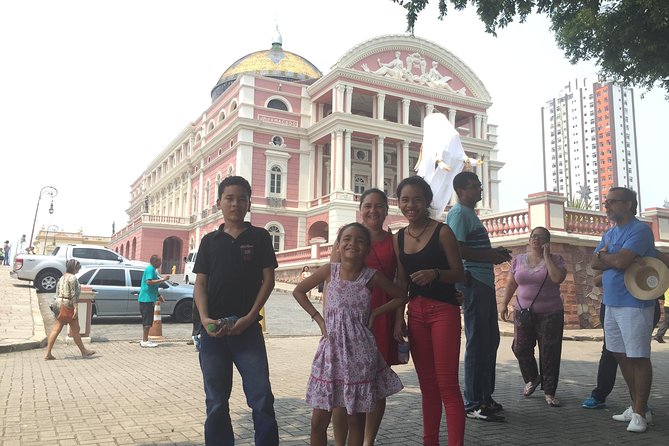
The tour gives Teatro Amazonas about an hour, and that is appropriate. This is not a quick photo stop. You enter the opera house and learn how materials and artists came from Europe to create a grand performance space in the middle of the Amazon.
The building makes the rubber boom easier to understand than a paragraph in a history book. When rubber brought money into Manaus, local leaders and wealthy business figures wanted the city to look modern, prosperous, and connected to Europe. The opera house was part of that ambition.
Look closely at the idea behind the building, not just its decorative details. Its presence raises a useful question: who had access to this wealth, and why did the city invest so heavily in European cultural symbols? A good guide can connect the building to the economy that made it possible and to the local identity that formed around it.
Admission is included, which helps justify the tour price. One practical warning is that the opera house can close for events or maintenance. A previous visit found it closed because of an upcoming event, while another took place during minor renovations in January. The exterior and surrounding square are still worthwhile, but an unexpected closure changes the experience considerably.
The quality of explanation matters here. Guides named Marcello and Milton have been praised for clear English and strong historical explanations. Another guide, Sergio, was described as having limited English, so if detailed interpretation is important to you, ask about the guide’s language ability before confirming.
Paço da Liberdade and the old Manaus center
Next, you see the area described as old Manaus, including Paço da Liberdade. This part of the route is less about one famous interior and more about reading the city’s facades.
The neo-classical style reflects the ambitions of the rubber era. Wide-looking civic buildings and formal details tell you that Manaus wanted to present itself as a serious capital, not simply as a distant trading settlement. Your guide can point out how the city’s public face was shaped by money from the rubber economy.
The former city hall now functions as a museum, giving this stop a direct link to local government. It helps fill in the gap between the opera house as a cultural symbol and the market as a place of commerce. You see how power, public life, and business occupied the same central area.
This is also where guide quality can change the pace of the visit. One person found the tour covered the major sights but did not provide much history. Another found the guide exceptionally good at explaining the significance of each place. If you want a scholarly study of Manaus, this is probably too short. If you want a clear framework for understanding the center, it can work very well.
The route is not just a parade of old buildings. It gives you a chance to notice contrasts. Grand facades sit beside ordinary city life, and local people continue using the center for practical reasons rather than as a preserved stage set. That contact with daily life was one of the reasons the tour appealed to past participants.
More History Tours in Manaus:
- Historic City Tour Manaus by car with 3 stops.
★ 4.9 · 18 reviews - Jewish Shared Tour Manaus – Sepharadite History -4 hours
★ 5.0 · 3 reviews - Private city tour in the historic center of Manaus
★ 5.0 · 2 reviews - Rio de Janeiro Historical Center Walking Tour
★ 4.5 · 336 reviews
Adolpho Lisboa Municipal Market and its three buildings

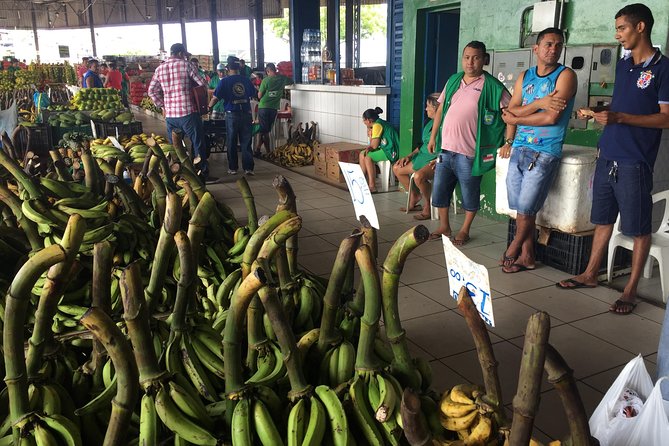
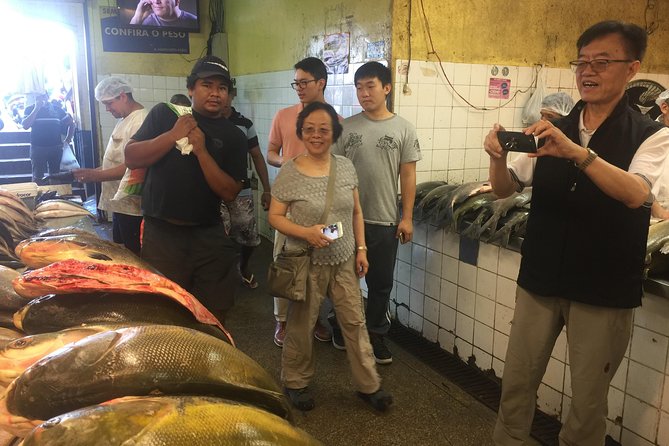
The market complex provides the most grounded part of the morning. Here you see three connected market buildings: the banana market, the fish market, and the municipal market.
Each building has its own character, and the group moves through the complex for about an hour. The market shows Manaus as a working city, not only as a place of grand rubber-boom monuments. Its products, sellers, and local routines give the historic center a more immediate feel.
I would pay attention to the contrast between this stop and Teatro Amazonas. The opera house represents wealth directed toward culture and prestige. The market represents the movement of food and goods through the city. Both are needed to understand Manaus, and the route puts them together without requiring a separate market excursion.
The market can also be the most demanding stop physically. It may be hot, humid, and crowded, and one past experience described a sticky first section during the walking portion. Rain is another concern during the wet season. The vehicle helps you move between stops, but it cannot keep you dry once you are inside the market area.
You do not need to buy anything for this stop to be worthwhile. Simply observing the different sections and asking your guide about local foods or drinks can add a personal layer to the visit. One guide was praised for sharing information about regional food and beverages, which is exactly the sort of detail that can make a city tour feel less like a checklist.
Rio Negro Palace and the story of changing fortunes
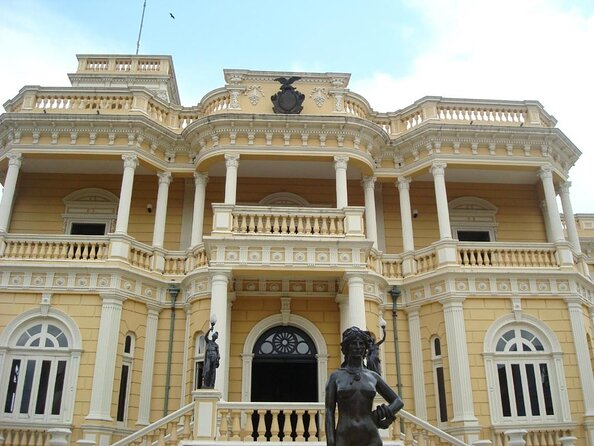
The final scheduled stop is Palácio Rio Negro, with about 30 minutes inside. The building was intended as a rubber baron’s home but later became a government office, giving you a neat example of how Manaus’s wealthy past was repurposed.
The shorter visit works because the palace supports the larger story rather than carrying the whole tour. You have already seen the opera house’s public ambition, the old city hall’s civic role, and the market’s commercial life. Rio Negro Palace brings that story into a private residence linked to the people who gained from the rubber economy.
Its change in function is worth considering. Buildings survive, but their meaning shifts. A home built to display private wealth can later serve public administration, turning a symbol of privilege into part of the city’s official life.
The palace is also useful for visitors who want more than architecture. Your guide can explain what the building says about the social structure of the rubber era, though the depth of that explanation depends on the person leading your group. The 30-minute visit keeps the morning moving, but it does not leave much room for a long museum-style examination.
Guides can make or break the history lesson
The strongest praise for this experience has focused on the guides. Milton Fernandes has been described as kind, very informed, and skilled at explaining the historical meaning of the places on the route. Marcello was praised for excellent English and an ability to connect local history with culture and daily life.
João, also called John, was praised for helping a late-arriving cruise passenger see the city efficiently. He was said to know the sites and local staff well, which can be useful when you are trying to make the most of limited time. Another guide named Aro was described as friendly and easygoing, with a relaxed pace that did not feel rushed.
Those details point to a real strength: this is not designed as a rigid, large-coach circuit. A small group lets you ask questions, request clarification, and sometimes adjust the emphasis. Several people found the guides patient and flexible, including when mobility concerns affected the pace.
Still, you should not assume every guide will provide the same level of English or historical detail. The experience has received some lower ratings because the explanation was not deep enough or communication was difficult. If the story of the rubber boom is your main reason for booking, confirm the language and ask for a guide who can offer detailed historical commentary.
Transport, weather, and timing concerns
The advertised duration is about three hours and 30 minutes, although one person described a four-hour experience. That small difference is not unusual for a private or small-group tour, since traffic, museum timing, and questions can stretch the schedule.
The car is used to connect the sights, not to replace all walking. This matters in Manaus because the center can be hot and rainy, and the market and historic areas are best understood at street level. Wear comfortable shoes and bring water, even though bottled water is included.
Rain can affect the experience. One previous outing involved repeated rainstorms during the wet season, though the guide continued with the tour. The stated policy requires good weather, and if poor conditions force cancellation, you are offered another date or a full refund.
The tour requires a minimum number of people to operate. If that minimum is not met, you are offered another date or experience, or a full refund. You can cancel for a full refund up to 24 hours before the start time, but late cancellations and late changes are not accepted.
Who gets the best value from this tour
I would choose this tour if you have only a morning in Manaus, are arriving by cruise, or want an efficient introduction before exploring more independently. It is also a good fit if you prefer a guide and private transport to figuring out the historic center on your own.
The route suits people who want a balance of architecture, local commerce, and basic history. You see the city’s polished public face at Teatro Amazonas and Paço da Liberdade, then get a more everyday view at the market. The Rio Negro Palace rounds out the picture with a look at private wealth and government use.
I would be more cautious if your priority is a long, academic explanation of Manaus. Three and a half hours is enough to cover the main sights, but not enough for every museum, neighborhood, or chapter of the rubber economy. A past three-star experience made this exact point: the route covers the highlights, but the history may feel brief.
I would also ask about the vehicle before booking if you dislike cramped transport. The tour uses private transportation, but that does not necessarily mean a roomy SUV or van. For two people, the car may be perfectly comfortable. For four larger adults, it may not be.
Should you book the Historical City Tour?
Book it if you want to see Manaus’s essential historic sights without spending the whole day walking in heat and rain. The included admissions, private transport, small group, and capable local guides can make $80 reasonable, especially when your time is limited.
Before paying, confirm three things: the vehicle size, the guide’s English ability, and whether Teatro Amazonas is open on your date. If those points are clear, this tour offers a practical route through the city’s most important buildings and markets, with enough local contact to make Manaus feel like a living place rather than a collection of monuments.
FAQ
How long does the Historical City Tour last?
The tour lasts approximately three hours and 30 minutes. One past experience lasted about four hours, so you should leave a little flexibility in your schedule.
Where does the tour begin and end?
It begins at 8:00 a.m. at Largo de São Sebastião, Rua 10 de Julho, Centro, Manaus. The tour ends back at the same meeting point.
What sights are included?
The route includes Teatro Amazonas, Paço da Liberdade and the old Manaus center, the Adolpho Lisboa Municipal Market complex, and Palácio Rio Negro.
Are entrance tickets included?
Admission to Teatro Amazonas and Palácio Rio Negro is included. Admission to Paço da Liberdade and the market is listed as free.
How many people can join the tour?
The group has a maximum of 12 people. The experience also requires a minimum number of participants to operate.
What happens if the tour is canceled because of weather?
If poor weather causes cancellation, you are offered a different date or a full refund. You can also cancel up to 24 hours before the start time for a full refund.
Just added in Manaus
- Tree Climbing in the Amazon★ 4.5 · 6 reviews
- Tucandeira Ants Indigenous Ritual★ 4.5 · 4 reviews
- Walking Tours in Manaus★ 3.5 · 16 reviews
- 4-day Amazon River Boat Tour From Manaus★ 5.0 · 10 reviews
- Transfer service from Porto to Manaus Airport★ 5.0 · 2 reviews
- Amazon Safari Tour in Manaus (Shared)★ 5.0 · 3 reviews
- Transfer service from Iberostar (Port) to Manaus Airport★ 5.0 · 1 review
- Private Tour Waterfalls Iracema & Asframa President Figueiredo★ 5.0 · 3 reviews
Rio de Janeiro City Tours, compared.

Rio’s City Tour – Tickets for Christ, Sugar Loaf & Lunch included
Read our review →
Full Day: Christ Redeemer, Sugarloaf, City Tour & Barbecue Lunch
Read our review →
Christ the Redeemer, Sugarloaf, Selaron & BBQ Lunch
Read our review →
São Paulo’s Full Day City Tour: Main City Sights in 7 Hours – (Shared Group)
Read our review →


Pub Crawl in Lapa with Cachaça Tasting and Live Samba
Read our review →
Rio’s Best_Corcovado, Sugar Loaf, Selaron, Cathedral and more
Read our review →Browse the lists this tour appears in