
Reviewed · HISTORICAL TOURS
Historical Rio Walking Tour
Rio’s past is hiding in plain sight. This four-hour walk connects Copacabana to the city center by subway, then leads you through grand theaters, old palaces, churches, plazas, and cultural centers. I especially like the local subway ride and the chance to see downtown as cariocas do, rather than arriving by a private vehicle. The small group, limited to 14 people, also gives the guide room to answer questions.
I also like the range of sights packed into the morning. You move from French architectural influence to Brazil’s imperial era, from grand public buildings to narrow colonial lanes. The main catch is simple: this is a walking tour, not a gentle sightseeing ride. You need comfortable shoes, moderate fitness, and tolerance for four hours on your feet.
In This Review
- Key points to know before booking
- Starting at Copacabana Palace and riding the metro
- Cinelândia: opera, art, and public grandeur
- Pedro Ernesto Palace and Federal Justice culture
- Tiradentes Palace and Brazil’s political past
- Praça XV, Paço Imperial, and the end of empire
- Colonial lanes at Travessa do Comércio
- Grandjean de Montigny and the move to neoclassical Rio
- Correios and CCBB: culture in former working buildings
- Candelária and the final church stop
- Guide quality and the small-group advantage
- Is $74.50 a fair price?
- Who should book this Rio walking tour?
- Should you book it?
- FAQ
- Where does the Historical Rio Walking Tour start?
- What time does the tour begin?
- How long does the tour last?
- Does the tour include hotel pickup?
- Is the subway ride included?
- How large is the group?
- Is the tour suitable for people with walking difficulties?
- What happens if the weather is poor?
Key points to know before booking
- The tour starts at Copacabana Palace at 10:00 a.m. You meet the guide at the hotel entrance before riding the subway downtown.
- The route covers Rio’s historic center on foot. Expect churches, government buildings, cultural centers, public squares, and colonial streets.
- The group can include up to 14 people. That is small enough for questions, though the experience may feel more personal when fewer people book.
- Guides are multilingual and highly praised. Lu, Matilde, and Leonardo are each singled out for warmth, clear explanations, and personal attention.
- The price is $74.50 per person. It includes the professional guide, but not food, drinks, hotel transfers, or stated admission fees.
- Free cancellation is available until 24 hours before departure. Bad weather may lead to an alternative date.
Starting at Copacabana Palace and riding the metro
You meet at the entrance of the Belmond Copacabana Palace Hotel on Avenida Atlântica at 10:00 a.m. This is a clear, recognizable meeting point, but hotel pickup is not included. If you are staying elsewhere in Rio, you need to make your own way to Copacabana.
The first leg is a subway ride to Cinelândia Station. That detail gives the tour a useful local feel. You are not simply driven between postcard sights. You ride public transport, as cariocas commonly do, and get a quick look at how the beach neighborhoods connect with central Rio.
The Cinelândia station itself is part of the story. It dates from the 1900s and reflects the French architectural influence that shaped parts of Brazil. The transition is striking: you begin near one of Rio’s best-known beaches and soon find yourself beneath the grand civic buildings of the old center.
The subway ride is also practical. It avoids spending the opening part of the tour in traffic and gets you directly to one of downtown Rio’s most important cultural districts. Once you arrive, most of the experience takes place on foot.
More History Tours in Rio de Janeiro
- Rio de Janeiro Historical Center Walking Tour
★ 4.5 · 336 reviews - Private Walking and Cultural Tour Rocinha-Rio de Janeiro
★ 5.0 · 239 reviews - Discover Rio Little Africa: A Cultural and Historical Journey
★ 5.0 · 238 reviews
Cinelândia: opera, art, and public grandeur
Cinelândia is one of the strongest parts of the route because several major buildings sit close together. You get a concentrated lesson in the city’s public ambitions, artistic taste, and political past without spending the day crossing Rio.
One stop is a French Renaissance-style building with paintings by leading Brazilian contemporary artists, along with folk and African art. The exact length of the visit and whether you enter should be confirmed with the guide, but the building adds an art focus to a morning otherwise centered on architecture and civic history.
The Municipal Theatre is a major visual reward. Built in 1909, Rio’s opera house is decorated with gilded mirrors, statues, murals, stained-glass windows, and chandeliers. Even if you only see it from outside, the façade and setting make a strong impression. If interior access matters to you, ask before booking because the tour information does not promise an admission visit.
Across the area, the National Library adds another layer. It holds Brazil’s bibliographical and documentary heritage and is recognized by UNESCO as the seventh-largest national library in the world. It is also the largest library in Latin America. That is not just a grand statistic. It helps explain why this part of town was built to project Rio as a capital of learning, culture, and government.
Your guide’s role matters here. The buildings can look like a series of impressive façades if you walk past alone. A good explanation connects their design to changes in Brazil’s public life. Leonardo, one of the named guides, is praised for being friendly, passionate about Rio, and strong on both local history and the lives of people in the city today.
Pedro Ernesto Palace and Federal Justice culture
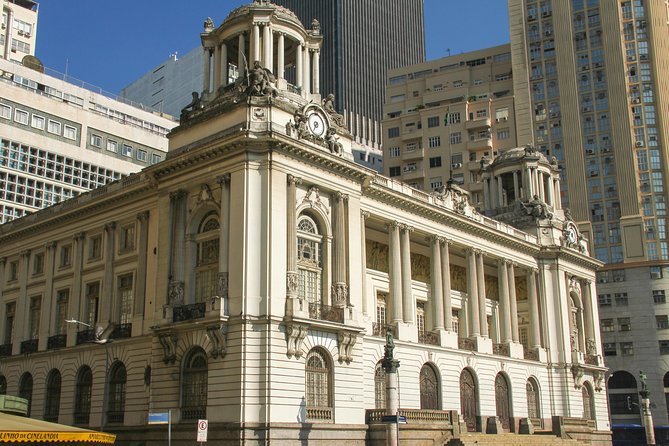
The Pedro Ernesto Palace, now home to Rio’s municipal council, continues the civic theme. Its main façade is carefully symmetrical, with detailed decoration, an entrance staircase, an upper gallery with paired columns, and two small temple-like structures at the corners.
This is a good stop for looking upward and slowing down. Downtown Rio rewards attention to details that are easy to miss when you are simply trying to get from one sight to the next. The palace belongs to one of the city’s valuable groups of historic buildings, and your guide can help you read the design rather than treating it as background scenery.
The Cultural Center of Federal Justice brings the route into the present. It supports public access to exhibitions, dance, music, courses, seminars, and lectures. Its program may vary, so do not book this walk expecting a particular exhibition or performance. The value here is seeing how former or historic public spaces continue to serve civic and cultural purposes.
I like this change of pace. The morning is not only about old churches and imperial buildings. It also shows Rio using its central district for current arts and public programming.
Tiradentes Palace and Brazil’s political past
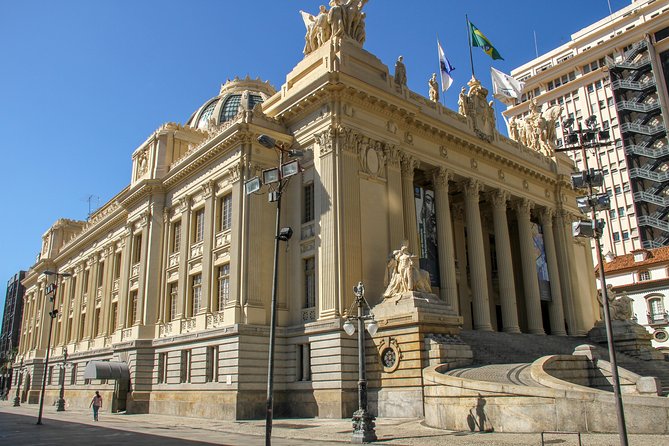
The Tiradentes Palace is one of the route’s grandest exteriors. Its Corinthian columns and eclectic design catch the eye, but the building’s political past gives it more weight. It served as the Brazilian National Congress from 1926 to 1960 and now houses the State Legislative Assembly.
You can expect the guide to explain how the building fits into Brazil’s changing government. This is where a walking tour earns its fee. A photo can record the columns, but it cannot explain why the building mattered, how its function changed, or how Rio’s central district became tied to national power.
The palace also helps break up the tour physically. After several cultural and religious sights, you get another large civic landmark with a different architectural language. Rio’s center is not a single-style district. Portuguese colonial buildings, French-influenced design, neoclassical work, eclectic public architecture, and later cultural institutions all appear within the same broad route.
More Walking Tours in Rio de Janeiro
- Rio de Janeiro: Rocinha Favela Walking Tour with Local Guide
★ 4.8 · 3,052 reviews - Rio De Janeiro: Half-Day Rocinha Favela Walking Tour
★ 4.7 · 2,272 reviews - 3 Hour Rocinha Favela Walking Tour with a Local Guide
★ 5.0 · 833 reviews - Favela Tour Rio de Janeiro – Vidigal Walking Tour by Russo Guide
★ 5.0 · 377 reviews
Praça XV, Paço Imperial, and the end of empire
Praça XV brings several periods together. The square sits near the ferry station for Niterói, Rua 1º de Março, Arco do Teles, and Paço Imperial. It is one of the places where Rio’s colonial, royal, imperial, and modern identities overlap.
Paço Imperial was built in 1743 as the home of the viceroys of Brazil. When the court of Dom João VI arrived in Rio, it became the seat of government for the Kingdom and the Empire. After Brazil became a republic, the building housed the Post and Telegraph service. It is now a cultural center connected to Brazil’s national heritage institute, with free admission throughout the year.
That free entry is a useful bonus, though the tour’s timing may not allow a long independent visit. You should ask the guide how much time is planned inside each cultural building. The experience is designed as a walking survey, so it may favor explanation and exterior viewing over extended museum visits.
The square also contains the fountain of Mestre Valentim, inaugurated in 1789. It is currently inactive. The Church of Our Lady of Monte do Carmo is another important feature, and the square has a direct connection to the end of slavery in Brazil. Celebrations took place here in 1888 after Princess Isabel signed the Golden Law.
That combination makes Praça XV more than a pretty stop. It links royal power, public celebrations, religion, and one of the most important turning points in Brazilian history. The guide can give the dates and names, but you should also take a moment to notice the scale of the square and how many major institutions gathered around it.
Colonial lanes at Travessa do Comércio
Travessa do Comércio is a short but memorable change from the formal plazas. The narrow passageways are closed to car traffic and retain some of the feel of colonial Rio. It is near Praça XV and offers the kind of street-level setting that grand monuments cannot provide.
I like this section because it gives you a sense of how the old center was organized before broad avenues and modern traffic reshaped the city. The alleys are not presented as a separate attraction with elaborate facilities. Their appeal is visual and atmospheric: old lines, tight spaces, and a slower pace.
This is also a place where good footwear matters. The route includes extended walking through central streets, and uneven or hard surfaces can become tiring. Comfortable shoes are specifically recommended, and you should take that advice seriously.
Grandjean de Montigny and the move to neoclassical Rio
Another important stop is a building commissioned in 1819 by King João VI from Grandjean de Montigny, a member of the French Artistic Mission. The work is considered an early record of neoclassical design in Rio.
Its importance is less about a single spectacular interior and more about the change it represents. Rio had been marked by colonial houses and Portuguese traditions. Neoclassical ideas gave the city a more European, cosmopolitan appearance and influenced later construction.
This is the sort of detail that can make the tour more rewarding for anyone interested in architecture. You are not only being shown attractive buildings. You are being shown how design followed political and cultural change. Ask questions here if architecture is your main interest, since the small group format should make that possible.
Correios and CCBB: culture in former working buildings
The Centro Cultural Correios occupies a building designed in an eclectic style at the start of the 20th century. It was first intended for a Brazilian Lloyd school, though that plan did not happen. For more than 50 years, the building served administrative and operational postal functions.
After being closed for renovation in the 1980s, it reopened partly renovated in 1992 for an ecological exhibition linked to the United Nations Conference on Environment and Development. Its formal cultural opening followed in 1993 with a philately exhibition. Today, it hosts theater, video, music, and art events.
This stop shows how old working buildings can be reused without losing their place in the city’s story. Exhibitions and programs can change, so your guide may focus on the building itself or note what is available during your visit.
The Centro Cultural Banco do Brasil, usually called CCBB, adds another major arts venue. It includes exhibition rooms, three theaters, a library, a cinema, and a video room in an art deco building that once stood in Rio’s financial district.
The route gives you a useful look at downtown as a cultural center, not simply a collection of old government buildings. If you enjoy museums and public art, this part may leave you wishing for more time. The tradeoff is that the tour covers a broad range of places in only four hours.
Candelária and the final church stop
The Church of Our Lady of Candelaria is one of central Rio’s main religious monuments. It is also a traditional setting for weddings among carioca society.
The church provides a strong final note because it returns the tour to religious architecture after the civic buildings and cultural centers. Its importance is both visual and social. The guide can explain its place in Rio’s public life, while you can pay attention to the scale and ornament of the building.
The tour information also highlights the Church of Our Lady of the Merchants among the important landmarks. Since the detailed route names Candelaria and Our Lady of Monte do Carmo, ask your guide exactly which churches will be entered and how long each stop lasts. The route appears to prioritize several exteriors and explanations, rather than long interior visits.
The activity ends back at the original meeting point. Since no hotel drop-off is included, plan your afternoon from Copacabana rather than from the final downtown sight.
Guide quality and the small-group advantage
The strongest praise goes to the guides themselves. Lu is described as both fun and well informed, with an ability to answer questions about history and connect it to life in Rio today. That second point is important. Downtown history can feel remote unless someone explains how the city’s past still affects daily life.
Matilde is praised for answering questions and for making room for a coffee and pastry break. That small act says something useful about the pace. The tour has a fixed route, but a considerate guide may adjust the rhythm when the group needs a short pause.
Leonardo is described as friendly, passionate about Rio, and effective at covering churches, monuments, and places of interest while discussing the people and history of the city and Brazil. Guide assignments can change, so you cannot count on a particular person. Still, the names give you a helpful sense of the style to expect.
The maximum group size is 14. That is not a private tour by definition, but it is far more manageable than a large coach group. One booking involved only three people and felt private, which allowed plenty of questions. If your date has light demand, you may get that same advantage. The activity is often reserved well ahead of time, with an average booking lead of 46 days, so reserving early is sensible if your schedule is fixed.
Is $74.50 a fair price?
At $74.50 per person, this is not the cheapest way to see downtown Rio. You are paying for a professional multilingual guide, route planning, historical interpretation, and a small-group format. Food, drinks, hotel transfers, and any separate admission costs are not included.
The value is strongest if you want context. You could walk around Praça XV, Candelaria, Tiradentes Palace, and the Municipal Theatre on your own, but you would need to research the buildings and work out the subway route yourself. The tour also organizes a wide sweep of the center into four hours, which is useful during a shorter Rio visit.
The value is weaker if you prefer to move slowly inside museums, stop often for meals, or explore independently. The route includes many cultural buildings, but the information does not promise lengthy interior visits at each one.
I would see the price as reasonable for a first orientation to historic Rio, especially if you can join a small group and ask questions. It is less compelling for repeat visitors who already understand the city center and prefer a self-guided pace.
Who should book this Rio walking tour?
You should consider it if you want to connect Copacabana with downtown in a practical way, enjoy architecture, or want a guide to explain Brazil’s royal, imperial, republican, religious, and artistic past. It also suits you if you like public transport and want a more ordinary local experience at the start of the day.
I would be cautious if walking is difficult. The operator recommends moderate physical fitness, comfortable shoes, and no walking limitations. Weather can also affect the experience, since it is subject to favorable conditions.
Book it early if the date matters, and be ready for a full morning on foot. Ask the guide about interior access, church visits, and the timing of the coffee break. Those details will help you decide if the pace matches your interests.
Should you book it?
I would book this tour if you have four hours available and want a thoughtful introduction to Rio beyond the beach and mountain views. The subway ride, compact route, named cultural landmarks, and strong guide feedback make it a useful first look at the city center.
I would skip it only if you dislike walking, want guaranteed museum interiors, or need hotel transport. For everyone else, the mix of public buildings, colonial lanes, churches, and personal guide time offers a solid way to meet Rio’s older center.
FAQ
Where does the Historical Rio Walking Tour start?
It starts at the entrance of the Belmond Copacabana Palace Hotel at Av. Atlântica, 1702, Copacabana, Rio de Janeiro.
What time does the tour begin?
The scheduled start time is 10:00 a.m.
How long does the tour last?
The tour lasts approximately four hours.
Does the tour include hotel pickup?
No. Hotel pickup and drop-off are not included. You meet at the Copacabana Palace, and the activity ends back at that meeting point.
Is the subway ride included?
The route includes a subway ride from Copacabana to downtown, ending at Cinelândia Station. The tour description lists the professional guide as included, but does not separately state subway ticket coverage.
How large is the group?
The maximum group size is 14 people.
Is the tour suitable for people with walking difficulties?
No. It is not recommended for people with walking difficulties. You should have moderate physical fitness and wear comfortable shoes.
What happens if the weather is poor?
The tour is subject to favorable weather conditions. If it is canceled because of poor weather, you are offered an alternative date. You can also cancel for a full refund if you do so at least 24 hours before the start time.
Just added in Rio de Janeiro
- Little Africa: Historical & Heritage Tour of Rio de Janeiro★ 4.5 · 7 reviews
- Petrópolis Historical Tour – Museum Ticket and Lunch!★ 3.0 · 9 reviews
- Centro Historico and Lapa – Santa Teresa Walking, Historical and Bohemian Tour★ 5.0 · 44 reviews
- Hiking to Christ the Redeemer A Journey to Rio’s Iconic Landmark★ 5.0 · 20 reviews
- Best Private Historic Day Tour of Rio de Janeiro★ 5.0 · 3 reviews
- Petrópolis, the Imperial City★ 4.5 · 8 reviews
- Hire Photographer, Professional Photo Shoot – Rio de Janeiro★ 3.5 · 3 reviews
- Hikking the Favela + Morro Dois Irmaos!★ 4.5 · 7 reviews
Historical Tours, compared.


Private Walking and Cultural Tour Rocinha-Rio de Janeiro
Read our review →
Discover Rio Little Africa: A Cultural and Historical Journey
Read our review →


Scenic Train ride to historical cities of Morretes and Antonina
Read our review →
Browse the lists this tour appears in