
Reviewed · FAVELA TOURS
Live an experience in the Rocinha Favela.
Rio looks different from Rocinha. This three-hour visit takes you into Brazil’s largest favela, where Andrea and other local guides explain daily life, community projects, architecture, public services, and the forces that shaped the neighborhood. I like that the experience goes beyond a quick photo stop, and I like the small group size, capped at 10 people.
The main consideration is that this is an active walking experience through steep streets, alleys, and stairways. You should also be comfortable entering a community where the emphasis is on listening and respect, not treating people’s homes as a backdrop. The $60 price feels fair if you want a guided introduction with local context, transport within Rocinha, and a direct look at community projects.
In This Review
- Key points to know before you book
- Why Rocinha offers a different view of Rio
- Meeting Andrea at São Conrado Metro
- Riding up to Rocinha’s highest point
- Learning how the community was built
- Capoeira from a community viewpoint
- Walking through alleys and social projects
- Safety, respect, and the right mindset
- Is $60 a fair price?
- Who will enjoy this Rocinha experience?
- Should you book the Rocinha tour?
- FAQ
- Where does the Rocinha experience begin?
- Where does the experience end?
- How long does the activity last?
- How many people can join the tour?
- Is transportation included within Rocinha?
- Can I cancel for a full refund?
Key points to know before you book
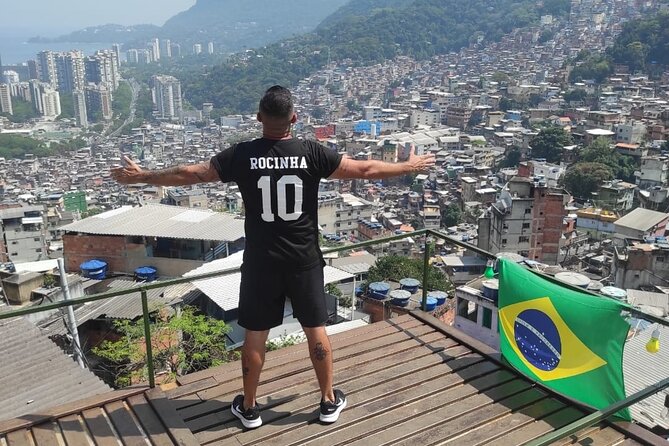
- Ride toward Rocinha’s highest point: Reach the upper part of the community by mototaxi or van, then take in broad views over Rio.
- Andrea receives especially warm praise: His friendly manner, care with safety, and clear explanations help ease first-time concerns.
- Capoeira and social projects add substance: The visit includes more than streets and viewpoints, with a chance to see community work in action.
- Expect roughly three hours: The route combines vehicle transport, walking, viewpoints, alleys, and project visits.
- The group is limited to 10 people: That makes questions and conversation easier than on a large coach tour.
- Meet at São Conrado Metro: The starting point is at Exit A, with the tour returning to the same place.
Why Rocinha offers a different view of Rio
Rio is often presented through beaches, mountains, and postcard viewpoints. Rocinha adds another part of the city’s story. It sits near the affluent districts of São Conrado, Gávea, Leblon, Ipanema, and Copacabana, yet its streets and daily routines feel far removed from the polished beachfront image most visitors first encounter.
I like this experience because it does not reduce Rocinha to a viewpoint or a quick drive past the edge. The route is meant to help you understand how the community was built, how its architecture developed, and how residents use local services and social projects.
That context matters. A favela is not simply a poor neighborhood waiting to be photographed. It is a lived-in community, with homes, businesses, families, traditions, and its own systems of movement. A guide who can explain those details helps you look beyond the dramatic views and see the place with more care.
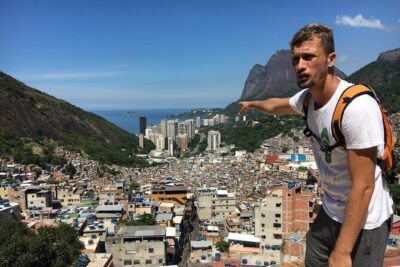
The tour also gives you a chance to connect Rocinha with the rest of Rio. From higher ground, you can look toward the beaches of Copacabana, Ipanema, and Leblon, as well as Vidigal. The contrast is striking, but it should not be treated as a simple divide between two separate cities. Rocinha is part of Rio, and this visit helps place it within the city’s wider geography.
More Favela Tours in Rio de Janeiro:
- Rio de Janeiro: Rocinha Favela Walking Tour with Local Guide
★ 4.8 · 3,052 reviews - Rio De Janeiro: Half-Day Rocinha Favela Walking Tour
★ 4.7 · 2,272 reviews - 3 Hour Rocinha Favela Walking Tour with a Local Guide
★ 5.0 · 833 reviews
Meeting Andrea at São Conrado Metro
You meet at Metrô São Conrado, Exit A, at Rua General Olímpio Mourão Filho, 320, in São Conrado. This is a practical meeting point near public transportation, and the tour finishes there as well. That return is useful because you are not left to work out a new route at the end of a busy morning or afternoon.
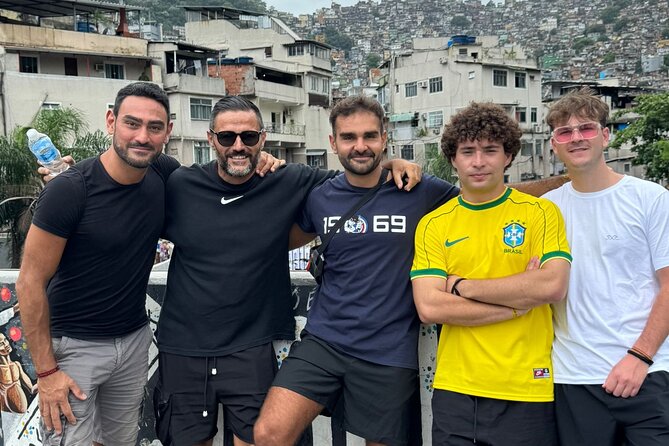
Andrea is the guide most closely associated with the experience. His approach earns praise for being warm, attentive, and reassuring, especially for people who arrive with concerns about safety. That does not mean you should switch off your common sense, but it does suggest that the guide takes the responsibility seriously.
Several accounts describe Andrea as someone who quickly moves from guide to friendly companion. That is important on a visit like this. You want someone who can explain the neighborhood without sounding as if he is delivering a canned speech, and you want a guide who understands when to slow down, answer questions, or clarify local customs.
The small group limit helps here. With no more than 10 people, you should have a better chance to hear explanations and ask about what you see. It also makes the walk less intrusive than a large group moving through narrow passages.
Riding up to Rocinha’s highest point
The route begins by heading upward, using a mototaxi or van to reach the highest point of the favela. This is one of the most memorable parts of the visit. Rocinha’s steep setting means that gaining height quickly gives you a strong sense of how the community fits into Rio’s hills.
The ride itself is part of the local rhythm. A mototaxi can move through streets more easily than a larger vehicle, while a van may be used depending on the circumstances. The supplied information does not promise one specific form of transport for every departure, so you should expect either option rather than plan around a particular vehicle.
At the top, the reward is the view. You can see across Rocinha and out toward some of Rio’s best-known beaches and nearby districts. It is an excellent place to get your bearings before walking down through the community.
I would not treat this as only a scenic outing, though. The guide uses the upper section to explain the neighborhood’s growth, its buildings, public services, and daily routines. Architecture becomes easier to understand when you are looking across the whole hillside rather than at one street at a time.
The route may also require a steady footing. The experience includes roads, alleys, and narrow passages, and the community is built on steep ground. Wear sensible shoes and expect a walk that is more practical than polished.
Learning how the community was built
One of the strongest parts of the experience is the explanation of Rocinha’s development. You hear about how the favela was built and how its physical form reflects the needs of the people who live there.
This is where a local guide adds real value. On your own, you might notice dense construction, colorful walls, shops, and narrow routes, but you would not necessarily understand how the neighborhood functions. The guide can connect what you see to housing, access, public services, and community life.
The explanations also help avoid a common mistake: assuming that every favela is the same. The tour focuses on Rocinha, with its own identity and history. You are not being given a broad lecture about every informal settlement in Brazil. You are seeing one specific community and hearing how it works from someone familiar with the territory.
I appreciate that the visit includes cultural elements as well as practical details. Learning about daily life alongside music, sport, and local projects gives you a fuller picture. It also makes the experience more human. You are not just studying buildings from the outside. You are being shown the activities that help shape the neighborhood.
Still, the quality of the visit depends heavily on the guide. Andrea’s warmth and local familiarity are repeated strengths of the experience. If he is leading your group, his personality may be a major part of what makes the tour work.
More things to do in Rio de Janeiro:
- Rio de Janeiro: 6-Stop Highlights of Rio with Lunch
★ 4.4 · 5,157 reviews - Christ the Redeemer Entry Ticket by Corcovado Train
★ 4.4 · 4,476 reviews - Rio’s City Tour – Tickets for Christ, Sugar Loaf & Lunch included
★ 5.0 · 4,389 reviews - Full Day: Christ Redeemer, Sugarloaf, City Tour & Barbecue Lunch
★ 4.5 · 3,142 reviews
Capoeira from a community viewpoint
During the descent, the route passes a laje, a rooftop or concrete terrace, where you may watch a capoeira project. This is a valuable stop because it shows culture in practice rather than as a staged performance created only for tourists.
Capoeira blends movement, music, rhythm, and martial arts traditions. Here, its importance comes from the setting and the project itself. You are seeing an activity connected to the community, not simply checking off another Brazilian cultural display.
The terrace also offers another chance to look across Rocinha. After seeing the neighborhood from its highest point, you are now closer to the streets and buildings. The two views work well together: one gives you the broad picture, while the other shows how people experience the hillside at ground level.
The exact length or format of the capoeira presentation is not specified, so you should think of it as an observation stop rather than a guaranteed full show. That is not necessarily a weakness. A real project may be active, informal, or dependent on what is happening that day.
Some accounts also describe a bar at a terrace viewpoint, where a drink can be enjoyed while looking over the community. Treat this as a possible part of the visit rather than a promised inclusion, since the formal description only specifically identifies the laje and capoeira project.
Walking through alleys and social projects
After the upper viewpoint and laje, you walk down through more of Rocinha. This is the section where the visit feels most direct. You pass through alleys and narrow lanes, see the way buildings and homes connect, and stop at additional social projects.
This walk asks for a respectful attitude. Keep your attention on the guide, avoid treating residents as scenery, and follow any instructions about where to stand or what to photograph. The point is to learn how the community functions, not to collect dramatic images.
I like that social projects are part of the route. They show effort, organization, and local action, which can get lost when a neighborhood is described only through problems. The visit gives you room to see how people create opportunities and support one another.
The route is not presented as a luxury sightseeing circuit. Streets can be tight, surfaces may be uneven, and the descent may be tiring. Most people can participate, but anyone with significant mobility limits should consider the terrain carefully. Service animals are allowed, according to the available details, and the tour operates near public transportation.
One review describes an impromptu football match with local children on a characteristic field. That sounds like the sort of spontaneous moment that can make the visit memorable, but it should not be treated as a guaranteed stop. The formal route highlights social projects, alleys, viewpoints, and capoeira.
Safety, respect, and the right mindset
Many first-time visitors hesitate before entering Rocinha. That reaction is understandable. You are going somewhere unfamiliar, and news coverage often reduces favelas to danger and conflict.
The experience is designed to address those concerns through a guide who knows the area and watches out for the group. People who went with Andrea describe feeling safe throughout the visit, and his attention to detail is one of the strongest reasons to choose this particular tour.
Still, no guided outing can remove every concern. You should follow the guide’s instructions, stay with the group, and avoid wandering away to explore on your own. Dress simply, carry only what you need, and ask before taking photographs of people, homes, or projects.
Your attitude matters as much as the guide’s. Come to listen. Do not expect poverty to be packaged as entertainment. You will get more from the visit if you see Rocinha as a community with challenges, pride, creativity, and ordinary routines.
That balance is one of the tour’s best qualities. The guide’s message is not only about what it means to visit a favela, but what it means to live there. The distinction is important. You leave with a more grounded view of Rio when you pay attention to people and place rather than searching only for dramatic stories.
Is $60 a fair price?
At $60 per person, the cost is reasonable for a small-group experience lasting about two to three hours. You are paying for a guide, local interpretation, the route through Rocinha, the uphill mototaxi or van transfer, and access to a series of viewpoints and community-related stops. Admission is included.
The value depends on what you want from a Rio tour. If you only want a high viewpoint, cheaper options may exist elsewhere. If you want to understand Rocinha through a local guide and see more than the main road, this price makes better sense.
The group cap of 10 also matters. A larger group might lower the cost, but it could make narrow streets harder to manage and reduce the chance to ask questions. Here, the smaller format supports conversation and a calmer pace.
The tour does not appear to include a full meal. A bar or drink may be available at a viewpoint, but you should not book this expecting a food-focused outing. Its gastronomic perspective refers more to seeing the beach districts and surrounding parts of Rio from Rocinha than to a formal tasting menu.
You also get some flexibility if plans change. Cancellation is free up to 24 hours before the start time for a full refund. Changes or cancellations made less than 24 hours before the start are not refunded, and the activity requires a minimum number of participants. If that minimum is not met, you are offered another date or experience, or a full refund.
Who will enjoy this Rocinha experience?
I would recommend it most strongly to you if you want a social and cultural perspective on Rio rather than another standard lookout. It suits curious visitors who are willing to walk, listen, and accept that the experience may feel less polished than a conventional sightseeing tour.
It is especially useful early in a Rio stay. After visiting Rocinha, the views toward Copacabana, Ipanema, Leblon, and Vidigal make more sense on a map and in real life. You begin to see how closely different parts of Rio sit beside one another, even when their daily realities differ.
It can also suit visitors who initially feel nervous about a favela visit. Andrea’s calm manner and attention to safety may help you feel at ease. Just remember that reassurance works best when paired with sensible behavior and respect for the neighborhood.
You may want to skip it if you dislike steep walking, narrow passages, or tours that focus on social realities. It is also not the best fit if you want a private, polished sightseeing vehicle that keeps you at the edge of the community.
Should you book the Rocinha tour?
Yes, if you want to understand a real part of Rio and are prepared to approach it respectfully. The strongest reasons are the upper-hill views, the explanations of community life, the capoeira project, and the chance to walk through Rocinha rather than simply photograph it from a distance.
Andrea appears to be a major asset, particularly for first-time visitors who worry about safety. The small group and return to São Conrado Metro make the outing practical, too.
Book it for context, conversation, and a closer look at daily life. Do not book it for guaranteed entertainment, a formal food tour, or a completely predictable schedule. At $60, it offers good value for an honest, locally guided introduction to one of Rio’s most misunderstood neighborhoods.
FAQ
Where does the Rocinha experience begin?
It begins at Metrô São Conrado, Rocinha, Exit A, at Rua General Olímpio Mourão Filho, 320, São Conrado, Rio de Janeiro.
Where does the experience end?
The tour ends back at the same meeting point.
How long does the activity last?
The experience lasts approximately two to three hours, with the itinerary listing three hours.
How many people can join the tour?
The maximum group size is 10 participants.
Is transportation included within Rocinha?
The route includes travel to the highest point by mototaxi or van, followed by walking through the community.
Can I cancel for a full refund?
Yes. You must cancel at least 24 hours before the local start time for a full refund. Cancellations or changes made less than 24 hours before the start are not refunded.
Just added in Rio de Janeiro
- Maracanã Stadium: Match Tickets with Welcome Drink★ 5.0 · 33 reviews
- Marco Nascer do Sol Private Tour in Rio de Janeiro★ 5.0 · 4 reviews
- Maracana Stadium Special Tour★ 3.0 · 1 review
- Maracana Stadium Guided Tour: Behind-the-Scenes Access★ 4.0 · 36 reviews
- Stadium Stories & Food: Join a Maracanã stadium tour with a Local★ 3.5 · 3 reviews
- Samba Night in Lapa Private Tour★ 5.0 · 6 reviews
- Little Africa Guided Tour with Transfer★ 4.5 · 6 reviews
- Little Africa Unveiled: Vibrant Afro-Brazilian Heritage in Rio★ 5.0 · 12 reviews
Favela Tours, compared.
3 Hour Rocinha Favela Walking Tour with a Local Guide
Read our review →
Favela Tour Rio de Janeiro – Vidigal Walking Tour by Russo Guide
Read our review →
Browse the lists this tour appears in