
Reviewed · RIO DE JANEIRO CITY TOURS
Full-Day Historic Private City Tour of Salvador with Lunch
Salvador rewards a full day of focused exploring. I like the private guide and air-conditioned vehicle, which make it easier to connect far-flung sights without solving Salvador’s transport puzzle yourself. I also like the mix of colonial churches, Afro-Brazilian culture, forts, markets, and local food. The tradeoff is a packed schedule: you walk quite a bit in Pelourinho, and some stops are brief or only viewed from outside.
At $170 per person, this is not a cheap city outing, but lunch, hotel pickup, private transport, and a professional guide are included. For a first visit, I see the price as reasonable if you value context and convenience. If you prefer slow museum visits or independent wandering, the many stops may feel rushed.
In This Review
- Key points before you book
- Why this tour works for a first day in Salvador
- Fort Santo Antonio da Barra and the first beach
- A local tile studio and the Bonfim church
- Dique do Tororó and Salvador’s African identity
- Mercado Modelo, shopping, and the included lunch
- Two hours in Pelourinho, Salvador’s historic core
- Rio Branco Palace, photography, and Jesuit art
- Lacerda Elevator and the Lower City connection
- Monte Serrat, coconut water, and the final church
- What the $170 price really includes
- Who should book this Salvador tour?
- Should you book it?
- FAQ
- How long does the Salvador city tour last?
- What is included in the tour price?
- Are drinks included with lunch?
- Is the tour private?
- Does the tour include hotel or port pickup?
- Is lunch included at a local restaurant?
- Can I enter Santo Antonio da Barra Fort?
- Are the Lacerda Elevator and São Francisco Church included?
- How much do the ice cream and coconut water cost?
Key points before you book
- A full Salvador overview in eight hours: You cover the waterfront, Upper and Lower City, Pelourinho, Bonfim, Mercado Modelo, forts, churches, and civic landmarks.
- Pelourinho gets the most time: The two-hour walking visit is the heart of the day, with cobbled streets, colonial squares, churches, and stories about Salvador’s past.
- The private format gives you flexibility: A guide can adjust explanations and walking pace, which helped one traveler with physical issues.
- Bahian culture is part of the tour: Bonfim, the orixá figures at Dique do Tororó, Candomblé, Catholic traditions, and Afro-Bahian photography all receive attention.
- Several extras cost a little more: Fort Santo Antonio da Barra costs R$12 to enter, ice cream at Sorveteria da Ribeira costs R$10 per scoop, and coconut water at Monte Serrat costs about R$5.
- The day involves real walking: Pelourinho’s uneven cobblestones and multiple church visits require comfortable shoes and enough stamina for a long outing.
Why this tour works for a first day in Salvador
Salvador is spread across two levels of the city, with the historic center inland from the bay and important religious and military sites farther out. Seeing it all independently in one day would mean combining cars, walking, elevators, and local transport. This tour puts those pieces together in one route.
You begin with broad orientation rather than immediately disappearing into the old center. The day includes the first beach associated with the Portuguese colonizers’ arrival, waterfront forts, religious sites, the modern football stadium area, the market, and the old city. That range helps you understand Salvador as more than a pretty colonial quarter.
The private arrangement matters here. You have a vehicle for the longer connections, then a guide for the places where local background adds real value. The group can be as large as 15 people, but the experience is described as private, so confirm the exact arrangement when booking if group size is important to you.
Past guide feedback gives useful clues about the service. Andre was praised for being kind, flexible, and helpful with a participant who had physical limitations. Marcos was described as speaking very good English and knowing Salvador well, though one account found his explanations uneven at some stops. Guide quality can shape the day, so it is worth stating your interests clearly at the start.
More History Tours in Salvador
- Salvador Historic Walking Tour – Pelourinho
★ 4.8 · 62 reviews - Historical African oriented City Tour
★ 5.0 · 52 reviews - Full City Tour Historic and Panoramic
★ 5.0 · 24 reviews
Fort Santo Antonio da Barra and the first beach
The opening photo stop is at Santo Antonio da Barra Fort, also home to the Nautic Museum of Bahia. You have about 20 minutes to walk around the area with your guide and take in the waterfront setting.
The fort itself is not included in the tour price. You can enter independently for R$12 per person, but that choice uses part of your limited time. If maritime displays interest you, paying the admission may be worthwhile. If you mainly want photographs and an introduction to Salvador’s position on the bay, the exterior stop may be enough.
The first beach linked with the Portuguese arrival adds useful context. It places the city’s early colonial story beside the water rather than treating Salvador’s past as something found only in churches and government buildings.
Several other museum and colonial-building references appear early in the route, including a silver art museum and a wood-and-painting museum. The exact visit time for these is not clearly set out, so ask your guide if you want to enter rather than simply pass by. An independence monument is also a drive-by photo stop, not a walking visit.
A local tile studio and the Bonfim church
At R. Augusto de Mendonça, 15, you stop at Atelier Casa de Prentice, a local tile painter’s studio. The visit lasts about 15 minutes and admission is free.
This is one of the day’s more personal touches. Instead of seeing only grand public monuments, you get a glimpse of a working local art space and the tile tradition that fits so naturally with Bahia’s Portuguese influence. Fifteen minutes is short, but it can break up the larger historical stops with something hands-on and contemporary.
The next major visit is Basilica do Senhor Do Bonfim, with about 30 minutes to explore. Bonfim is important not only for its Catholic identity but also for the way Catholic devotion connects with African religious traditions in Bahia. Your guide explains the relationship between Catholic saints and African orixás, including the local beliefs that make Salvador’s religious life distinctive.
I would treat this as a cultural visit first and a church photo stop second. The value lies in understanding how different traditions meet here. Dress and behave respectfully, since this remains a functioning place of worship.
Dique do Tororó and Salvador’s African identity
Dique do Tororó gives you about 20 minutes to see the large images of African orixás beside the water. You also view the football stadium from outside.
This is a short stop, but it carries a lot of meaning. The orixá figures provide a clear visual introduction to the African roots of Bahian culture. The tour’s attention to Candomblé and Afro-Bahian traditions is one of its strongest features, though the balance depends on your guide.
One piece of feedback found the guide spent much of the day discussing Candomblé. That subject is valuable, but you may want to ask for a wider mix of history, architecture, food, and daily life if that is your preference. A good private tour should respond to your interests rather than deliver one fixed lecture.
More Rio city tours:
- Salvador City Tour – Discover Brazil’s First Capital En, It, Es
★ 5.0 · 217 reviews - Private City Tour in Salvador
★ 5.0 · 110 reviews - Afro-Brazilian Roots Private City Tour in Salvador
★ 4.7 · 88 reviews - Combo Arraial da Ajuda / Trancoso / Espelho / City tour – by Coconut Experience
★ 4.5 · 29 reviews
Mercado Modelo, shopping, and the included lunch
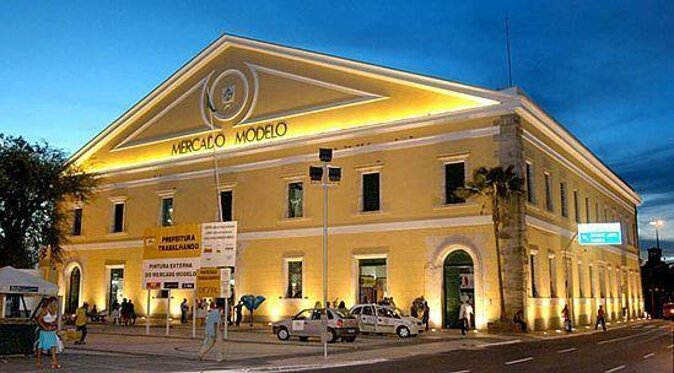
Mercado Modelo receives about 45 minutes. The market is the place to browse local handicrafts and look for souvenirs, so this is your main shopping opportunity.
I would set a budget before entering. Markets can swallow time and attention, especially during a day already full of churches and old streets. If shopping is not a priority, 45 minutes may seem generous. One piece of feedback suggested replacing some market time with another location, which tells you exactly where the schedule may feel less rewarding for culture-focused visitors.
Lunch is included at a local restaurant, with Bahia’s specialties listed as part of the experience. Drinks are not included, so keep money available for beverages. The exact restaurant and menu are not specified, which means you should not book this expecting a named dining destination or a fixed tasting menu.
Still, including lunch is useful. You avoid spending another part of the day finding a restaurant, and a local meal gives the historical material a practical connection. Ask your guide what dishes are being served and which Bahian ingredients or traditions are involved.
Two hours in Pelourinho, Salvador’s historic core
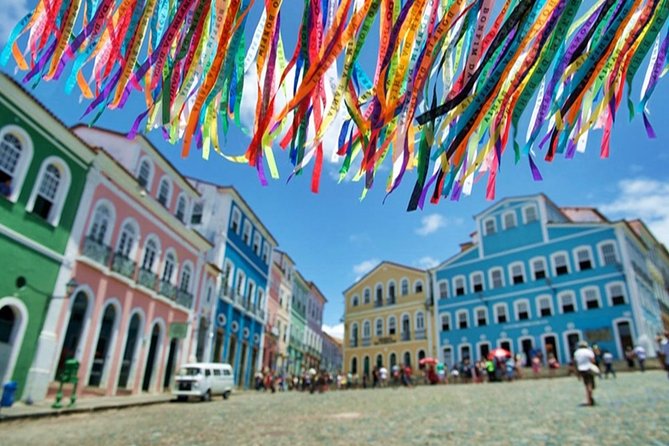
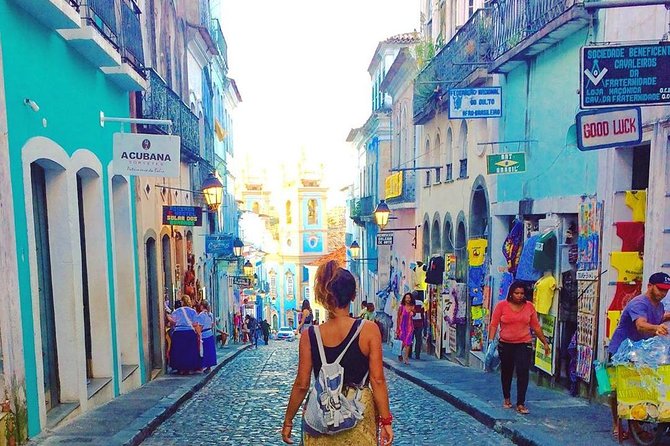
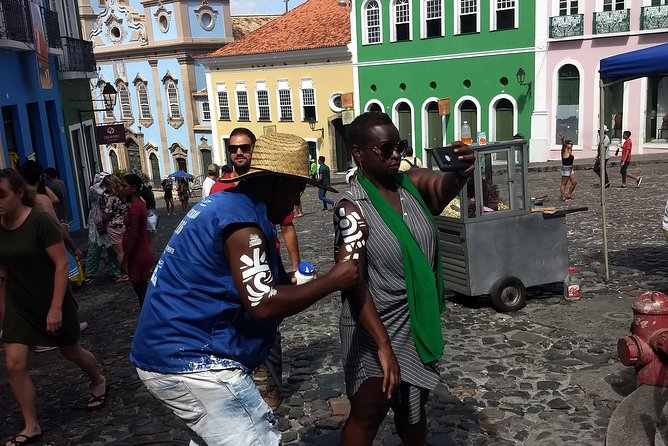
Pelourinho is the center of the tour and receives about two hours on foot. You walk through a group of five squares lined with colonial buildings and follow cobbled streets through the main historic part of Salvador.
This is where the private guide earns the price. The façades are attractive, but the streets make more sense when someone explains what you are seeing and how the district fits into Brazil’s past. You get time to look up at the colors, doorways, balconies, and church exteriors instead of merely passing them from a vehicle.
The drawback is physical and practical. The cobbles can be tiring, and the day already includes several walks. One account called the entire route a little rushed because of the number of stops, with Pelourinho requiring especially much walking. Wear shoes with good grip and tell the guide early if you need fewer stairs, a slower pace, or more sitting breaks.
Your experience inside the historic center may also depend on how actively the guide leads. One account found that the guide sometimes left the group to wander inside the San Francisco church and around the main square. That can be pleasant if you like freedom, but it is less satisfying if you want detailed explanations at every building.
Rio Branco Palace, photography, and Jesuit art
Palacio Rio Branco is an optional 15-minute stop. Its architecture is attractive, and the building now serves as a memorial connected with the state’s governors and the democratic republican period.
Entrance is not guaranteed because opening hours are irregular. Think of this as a possible bonus, not a promised interior visit. If the doors are closed, the stop still gives you a chance to see the building from outside.
The Espaco Pierre Verger da Fotografia Baiana takes about 10 minutes. It focuses on photography connected with the Afro-Bahian diaspora. The visit is brief, but it adds a modern visual record to a day otherwise weighted toward churches, forts, and colonial structures.
The Cathedral Basilica of Salvador offers a longer 30-minute visit. Admission is included, and the main attraction is its Jesuit ecclesiastical art, described as among the finest in South America. This is an important distinction in value: some sites require extra payment, but the cathedral is already covered.
Lacerda Elevator and the Lower City connection
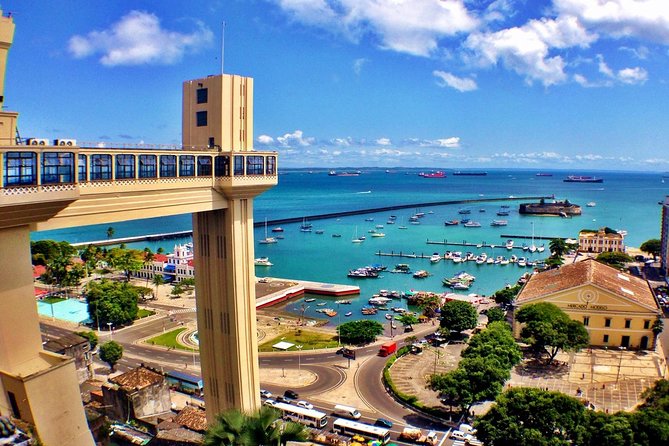
The Lacerda Elevator is not just a photo backdrop. You ride it for about 15 minutes, experiencing the practical link between Salvador’s Upper and Lower City.
The ride itself is short, but its meaning is larger. Salvador’s geography becomes easier to understand when you physically move between levels rather than simply hearing about the divide. This is one of the tour’s most efficient stops, since it combines transportation, city views, and a historic landmark in one brief experience.
The elevator admission is included. Keep your camera ready, but listen to the guide as well. This is one of those places where a few minutes of explanation can turn a simple ride into a clearer picture of how the city functions.
Monte Serrat, coconut water, and the final church
At Forte de Nossa Senhora de Monte Serrat, you walk around the outside for about 15 minutes and stop for photographs and coconut water. The fort belongs to the Army and is closed to visitors, so interior admission is not part of the plan.
The reward is the view across Salvador and the bay. Coconut water costs about R$5 per person, so carry a little Brazilian currency or confirm payment options with your guide.
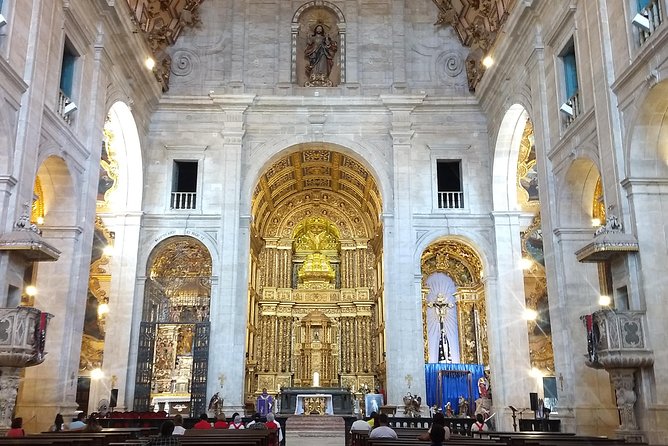
The last major religious stop is Igreja e Convento de São Francisco, with about 30 minutes inside. Admission is included. The church is known for its Portuguese tile collection and extensive gold-leaf decoration, making it one of the day’s strongest architectural interiors.
Give this visit your attention. Gold-covered church interiors can become visual overload after a long day, and the guide’s explanation matters. If you want more detail here, say so. One account specifically wished for more pointing out of interesting features inside the convent, while another found the guide highly informed and personable overall.
What the $170 price really includes
The $170 per-person price includes an eight-hour private experience, professional guide, hotel or port pickup and drop-off, air-conditioned vehicle, and lunch. That is a useful bundle in Salvador, where the distances between stops would otherwise take planning and separate fares.
The value is strongest for first-time visitors, people arriving by cruise ship, and anyone who wants a broad introduction without renting a car. It is also helpful if you are traveling with family or friends and want to shape the pace around the group.
The value is weaker if you care mostly about one neighborhood. You could spend a full day in Pelourinho and nearby churches at a slower pace, but you would miss the forts, Bonfim, Dique do Tororó, Monte Serrat, and the wider city view. This tour chooses range over lingering.
You should also budget for optional costs. Fort Santo Antonio da Barra is R$12 to enter, ice cream at Sorveteria da Ribeira costs R$10 for one scoop and one flavor, coconut water at Monte Serrat costs about R$5, and drinks at lunch are extra. Sorveteria da Ribeira has served its ice cream since 1931, so this is a fun food stop if you want something tied to local tradition.
Who should book this Salvador tour?
I would recommend it to a first-time visitor who wants the city explained rather than simply photographed. It suits couples, friends, solo visitors who prefer a guide, and cruise passengers who need pickup and a reliable full-day route.
It is also a good choice if you have limited time in Salvador and want to see both the historic center and outlying sites. The strong rating of 4.9 from 50 reviews and a 96 percent recommendation rate support the idea that the format works well for most people.
I would hesitate if you dislike packed schedules, shopping stops, or walking on uneven streets. You should also be clear about your preferred balance of religion, Afro-Bahian culture, architecture, photography, and food. The guide can make the same itinerary feel thoughtful and personal, or simply fast, depending on how the day is handled.
Free cancellation is available up to 24 hours before the start time for a full refund. Changes or cancellations made less than 24 hours ahead are not accepted for a refund. The tour requires at least two people per booking, and confirmation is provided when you book.
Should you book it?
Book this tour if you want a broad, guided introduction to Salvador in one day. The combination of Pelourinho, Bonfim, Afro-Brazilian culture, colonial churches, forts, the elevator, lunch, and private transport gives you a useful first picture of the city.
Skip it if your ideal day means staying in one neighborhood and studying every church at length. For most first-time visitors, though, the convenience and range justify the cost, especially when you have only one full day to get your bearings.
FAQ
How long does the Salvador city tour last?
The experience lasts approximately eight hours.
What is included in the tour price?
Lunch, a professional guide, hotel or port pickup and drop-off, and transportation in an air-conditioned vehicle are included.
Are drinks included with lunch?
No. Drinks are not included, so you should budget separately for them.
Is the tour private?
Yes. It is described as a private tour, with a maximum of 15 participants.
Does the tour include hotel or port pickup?
Yes. Pickup and drop-off at your hotel or port are included.
Is lunch included at a local restaurant?
Yes. Lunch at a local restaurant is included, and Bahia’s specialties are part of the food experience. The exact menu is not specified.
Can I enter Santo Antonio da Barra Fort?
Entry is optional and not included. Admission costs R$12 per person.
Are the Lacerda Elevator and São Francisco Church included?
Yes. Admission to the Lacerda Elevator and Igreja e Convento de São Francisco is included.
How much do the ice cream and coconut water cost?
Ice cream at Sorveteria da Ribeira costs R$10 per scoop and one flavor. Coconut water at Monte Serrat costs about R$5 per person.
More of Salvador and Bahia
- Round trip transfer, Salvador, Bahia, Brazil
★ 5.0 · 228 reviews - Cooking class in Salvador, an authentic dinning experience
★ 5.0 · 132 reviews - Tour to the Frades Islands and Itaparica, from Salvador – Ba
★ 4.0 · 130 reviews - Transfer Salvador Airport / Hotel Litoral Norte
★ 5.0 · 111 reviews
Just added in Salvador
- Mãe Tereza Ecological Park | A peaceful paradise, perfect for relaxing!★ 4.5 · 19 reviews
- Full Day Tour in Trancoso with Chocolate Factory★ 4.5 · 35 reviews
- Horse back riding and Eco tourism food and fun.★ 5.0 · 1 review
- Salvador: Schooner Cruise with Pickup and Itaparica Stop★ 3.8 · 5 reviews
- Salvador: Traditional Drumming and Percussion Workshop★ 4.4 · 10 reviews
- PROMO Salvador: Interactive Art and Culture Private Tour★ 5.0 · 2 reviews
- Salvador: 3-Hour Percussion Class★ 4.9 · 10 reviews
- Salvador: Cultural Treasure – Samba de Roda.★ 4.9 · 51 reviews
Rio de Janeiro City Tours, compared.

Rio’s City Tour – Tickets for Christ, Sugar Loaf & Lunch included
Read our review →
Full Day: Christ Redeemer, Sugarloaf, City Tour & Barbecue Lunch
Read our review →
Christ the Redeemer, Sugarloaf, Selaron & BBQ Lunch
Read our review →
São Paulo’s Full Day City Tour: Main City Sights in 7 Hours – (Shared Group)
Read our review →


Pub Crawl in Lapa with Cachaça Tasting and Live Samba
Read our review →
Rio’s Best_Corcovado, Sugar Loaf, Selaron, Cathedral and more
Read our review →Browse the lists this tour appears in